From U-Tubes To Digital Manometers: Measuring Small Pressures Properly
Air in a duct, gas at an appliance, the pressure across a filter: small pressures need an instrument built for them.
This guide explains how manometers work, the common types, how to take a correct reading step by step, and how to choose one for your lab, plant or field work.
What Is A Manometer?
A manometer is an instrument that measures pressure, usually low pressure or the difference between two pressures. The classic version is a U-shaped tube part-filled with liquid: apply pressure to one side and the liquid rises on the other, and the height difference tells you the pressure.
Digital manometers do the same job with a pressure sensor and a display. Either way, manometers are the instrument of choice when the pressure is too small for an ordinary dial gauge to read well, such as air in a duct, gas at an appliance, or the pressure difference across a filter.
How Does A Manometer Work?
A liquid manometer works by hydrostatic balance. The pressure you apply pushes the liquid down on one side until the weight of the raised column on the other side balances it. The taller the column, the higher the pressure.
The formula:
P = ρ × g × h
Pressure equals liquid density (ρ) times gravity (g, 9.81 m/s²) times the height difference (h). With water (about 1,000 kg/m³), a 10 mm difference is about 98 Pa, and one inch of water column is about 249 Pa.
Two things follow from that formula. Only the vertical height difference counts, not the tube's width or shape. And a lighter liquid gives a taller column for the same pressure, which is why low-range manometers use water or light gauge oil and why old high-range instruments used mercury, about 13.6 times denser than water.
Digital manometers replace the column with a sensor element that flexes under pressure and converts it to an electrical signal. Converting between the units these instruments use is easy with our pressure unit converter.
Common Manometer Applications
- •Duct, fan and airflow pressure in HVAC
- •Gas supply and appliance pressure checks
- •Pressure drop across filters
- •Room-to-room pressure in cleanrooms and labs
- •Vacuum measurement in process and lab equipment
- •Calibrating other low-pressure gauges
Types Of Manometer And What Each One Is For
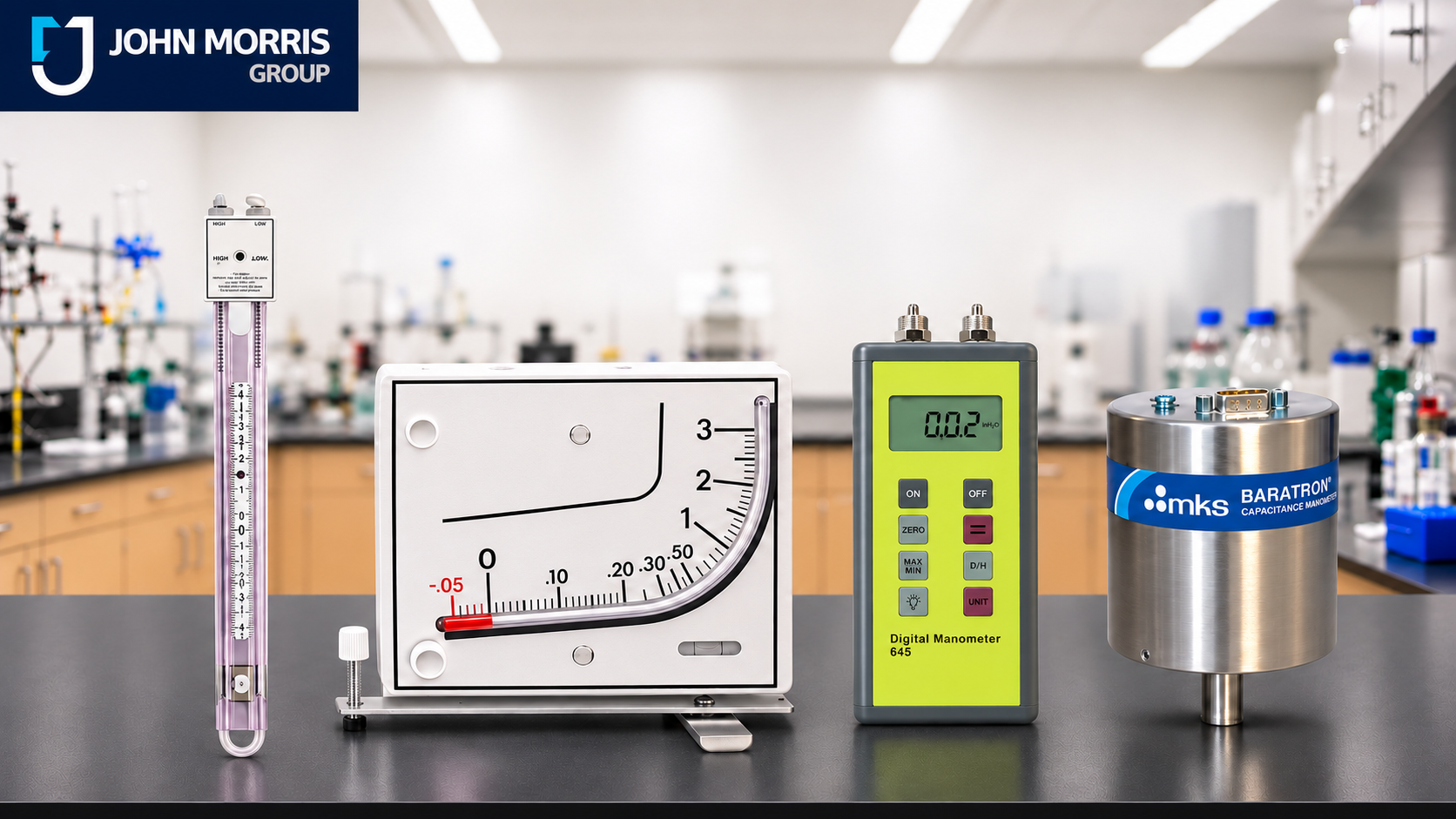
Every manometer measures pressure, but they suit very different jobs. Here is the whole family at a glance, then a closer look at each. The categories overlap: they describe how an instrument is built (U-tube, inclined), how it senses pressure (digital, capacitance) and what it measures (differential). A digital manometer is often differential too, and a micromanometer is a high-resolution digital differential instrument.
| Type | How It Works | Typical Use | Main Advantage |
|---|---|---|---|
| U-tube manometer | Liquid in a U-shaped tube. Pressure is the height difference between the two legs. | Teaching labs, quick checks, calibrating other gauges | No power, no drift, inherently accurate |
| Slack-tube manometer | A flexible U-tube that rolls up for the field. | Duct and fan tests, gas pressure checks | Portable U-tube accuracy |
| Well-type manometer | One leg is a wide reservoir, so you read a single column. | Bench and panel use | One reading instead of two |
| Inclined manometer | The reading leg is tilted, stretching small height changes along the scale. | Low draught, filter and airflow pressures | About 5.8× more scale at a 10° slope |
| Digital manometer | A pressure sensor and display replace the liquid column. | HVAC, gas, cleanrooms, field work | Units on demand, logging, no fluid |
| Differential manometer | Two ports read the difference between two pressures. | Filters, room-to-room pressure, pitot tubes | Measures what actually matters across a barrier |
| Micromanometer | A high-resolution digital manometer for very small pressures. | Air balancing, cleanroom validation | Fine resolution at the low end |
| Capacitance manometer | A thin diaphragm forms one plate of a capacitor; pressure moves it. | Vacuum systems, process tools, freeze drying | Absolute reading that does not depend on gas type |
U-Tube Manometer
The original and still the reference. A transparent U-tube holds water or gauge oil; connect one leg to the pressure and leave the other open (gauge pressure) or connect it to a second pressure (differential). It needs no power and cannot drift, which is why U-tubes are still used to check other instruments. The slack-tube version is a flexible U-tube that rolls up into a case for site work.
Well-Type Manometer
One leg is replaced by a wide reservoir. Because the reservoir's level barely moves, you only read the single narrow column, which halves the reading work and suits bench and panel instruments.
Inclined Manometer
The reading leg is tilted. The liquid has to travel further along a sloped tube to rise the same height, so the scale is stretched: at a 10° slope it is about 5.8 times longer than a vertical one. That makes small pressures, such as flue draught or filter drop, far easier to read. The scale is already marked in true pressure, so no maths is needed.
Differential Manometer
Any manometer with two pressure connections can read the difference between them, and many digital models are built around it with two labelled ports. Differential readings are what you want across a filter, between two rooms, or across a pitot tube to work out air velocity.
Micromanometer
A high-resolution digital manometer designed for very small pressures, where single pascals matter. Air balancing and cleanroom validation are the typical jobs.
Capacitance Manometer
The type most manometer guides leave out. A thin metal diaphragm forms one plate of a capacitor; as pressure deflects it, the capacitance changes. Capacitance manometers read absolute pressure and, unlike many vacuum gauges, the reading does not depend on which gas is present. That makes them a common choice for vacuum processes, semiconductor tools and freeze drying. The MKS Baratron range is a well-known example, with full-scale ranges from 1 to 25,000 Torr.
Digital Manometer: How It Differs From A Liquid Manometer
A digital manometer measures the same pressures as a liquid column, but with an electronic sensor. You get a number on a screen in whichever unit you choose, no fluid to fill, level or spill, and features a tube can't offer: hold, min/max, zeroing at the press of a button and, on many models, data logging.
The trade-offs are that it needs batteries, its accuracy is a percentage of its range, and it should be checked against a reference periodically. A Cole-Parmer digital manometer, for example, is accurate to ±0.5% of full scale, so pick a range close to the pressures you actually measure. The same series runs from 1 inWC up to a 100 psi model.
For most HVAC, gas and cleanroom work, digital has replaced the tube. Liquid manometers still win as a power-free reference and for teaching, because you can see the physics happen.
Manometer Vs Pressure Gauge, Differential Gauge And Barometer
These four instruments all read pressure, which is why the names get mixed up. In parts of Europe "manometer" is even used for any pressure gauge. Here is how they actually differ.
| Criteria | Manometer | Pressure Gauge | Dial Differential Gauge | Barometer |
|---|---|---|---|---|
| What it measures | Gauge, differential or absolute pressure, usually small | Gauge pressure, usually higher | Pressure difference between two points | Atmospheric (absolute) pressure |
| How it works | Liquid column height, or a sensor in digital types | Bourdon tube or diaphragm moves a needle | Diaphragm and magnet drive a needle | Mercury column or sealed aneroid capsule |
| Typical range | Pascals to a few psi (vacuum for capacitance types) | From a few psi to thousands of psi | Pascals to a few kPa | Around 100 kPa |
| Best for | Low pressures, airflow, calibration, gas checks | Process lines, compressed air, hydraulics | Permanent wall-mounted room or filter monitoring | Weather and absolute reference |
Rule of thumb: under a few psi, or when you need a difference between two points, use a manometer. For process lines and anything above that, a pressure gauge or transmitter is the better tool.
How To Read A Manometer
1. Level It
Liquid manometers must sit level or plumb. Inclined models have a spirit vial for this, because a tilted instrument gives a wrong reading.
2. Zero It
For gauge and differential models, open both ports to the air, then set the liquid to zero (inclined models have a zero-adjust plunger) or press zero on a digital model. For absolute instruments, follow the manufacturer's zeroing procedure instead.
3. Connect The Right Port
Positive pressure goes to the high port; for vacuum use the low port; for differential connect both. Kinked or leaking tubing is the most common source of error.
4. Read At Eye Level
Read water at the bottom of its curved surface (the meniscus). Mercury curves the other way, so read the top. Looking from above or below adds parallax error.
5. Read Both Legs
On a U-tube, pressure is the total height difference. On a zero-centred scale, add the rise in one leg to the fall in the other.
6. Note The Units
Check whether the scale reads inches of water, mm of water, Pa or mbar, and convert if your specification uses something else.
Worked example: on a zero-centred water U-tube, one surface rises 8 mm and the other falls 8 mm. The total height difference is 16 mm, not 8 mm.
ΔP = ρ × g × h = 1,000 × 9.81 × 0.016 ≈ 157 Pa (1.57 mbar)
The higher pressure is on the side where the liquid has been pushed down. That leg is connected to the higher-pressure point.
Gas Manometer: Checking Gas Pressure
A gas manometer is simply a low-range manometer used on gas supplies and appliances. Gas is delivered at low pressure, so a manometer is the right tool to check the supply pressure and the burner pressure against the appliance data plate, and to run tightness tests on pipework.
Water-column manometers did this job for decades; today most technicians carry a digital unit. For gas work, look for a model rated for natural gas and, where flammable atmospheres are possible, approved for intrinsically safe use. The Cole-Parmer digital manometers in our range carry that approval, and the roll-up slack-tube manometer is still a popular power-free backup.
One caution: in Australia gas appliance work is licensed work. This guide explains the instrument, not the test procedure, which belongs to a qualified gas fitter following the manufacturer's instructions.
What To Look For
- •Rated for natural gas as well as air
- •Intrinsically safe approval for hazardous areas
- •A range close to the pressures you test
- •Selectable units to match the data plate
- •Hold and zero functions for one-handed use
Where Manometers Are Used In Labs And Buildings
Fume Cupboards And Biosafety Cabinets
Differential manometers monitor exhaust and filter pressure so a drop in airflow is noticed before it becomes a safety problem.
Cleanrooms
Rooms are kept at small pressure differences so air flows from clean to less clean areas. A differential manometer or data logger confirms the cascade is holding.
Filter Loading
Pressure drop across a filter rises as it clogs. Reading it tells you when to change the filter instead of guessing.
Airflow With A Pitot Tube
A differential manometer on a pitot tube gives the velocity pressure in a duct, from which air speed and flow are calculated.
Vacuum Systems
Capacitance manometers give accurate absolute readings in vacuum ovens, freeze dryers and process chambers, independent of gas type.
Teaching Labs
Liquid manometers show the physics directly. Multi-tube sets such as the GUNT ten tube manometers read water depths along a hydraulics flume.
Manometer Units: inH₂O, mmH₂O, Pa And mbar
Manometers are often scaled in height of liquid (inches or millimetres of water) rather than pascals, because that is literally what they measure. Use this table to translate, or the pressure converter for other values.
| Unit | Equals | Or | Or |
|---|---|---|---|
| 1 inH₂O | 249.1 Pa | 2.491 mbar | 0.0361 psi |
| 1 mmH₂O | 9.81 Pa | 0.0981 mbar | 0.00142 psi |
| 1 mbar | 100 Pa | 0.401 inH₂O | 10.2 mmH₂O |
| 1 kPa | 1,000 Pa | 4.01 inH₂O | 102 mmH₂O |
| 1 mmHg (torr) | 133.3 Pa | 1.333 mbar | 13.6 mmH₂O |
| 1 psi | 6,895 Pa | 27.68 inH₂O | 68.95 mbar |
Inches of water use the 4 °C water reference (249.089 Pa). Some HVAC instruments use a 20 °C or 60 °F reference, which reads about 0.1% to 0.2% differently.
How To Choose A Manometer
Range And Resolution
Choose a full scale close to your working pressure. Accuracy is usually quoted as a percentage of full scale: at ±0.5% of full scale, a 100 psi digital manometer is accurate to ±0.5 psi (about ±13.8 inWC), so it cannot meaningfully read a 1 inWC cleanroom pressure, while a 1 inWC model can. Resolution, the smallest digit on the display, is not the same as accuracy. On differential models, also check the maximum line pressure and overpressure limits.
Gauge, Differential Or Absolute
Open-to-air readings need gauge; filters and rooms need differential; vacuum and process work often need absolute, which is where capacitance manometers come in.
Liquid Or Digital
Liquid needs no power and never drifts. Digital is faster, switches units, and suits field work and logging.
Data Logging
For audits and trend monitoring, a logger such as the Extech SDL710 records time-stamped readings to an SD card; the TPI 665 stores up to 5,000 points.
Hazardous Areas
Around natural gas or solvents, use an instrument approved for intrinsically safe operation.
Calibration
Ask for a calibration certificate with digital units and check them periodically against a reference, which is still often a liquid manometer.
Manometers At John Morris Group
Examples for common laboratory and field applications, from a power-free U-tube to an absolute capacitance manometer for vacuum. For general field checks across HVAC, gas and process lines, the TPI 665 covers ±101.5 psi and reads in seven units.
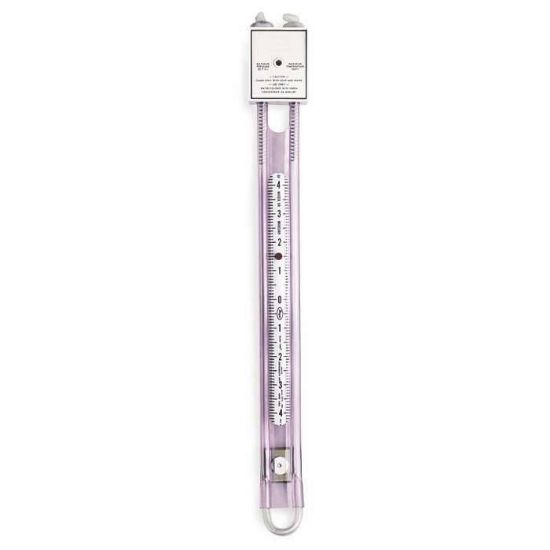
Cole-Parmer Slack Tube Manometer, 24 inWC
A roll-up U-tube manometer in unbreakable moulded nylon. It reads static pressure, vacuum or differential pressure, clips magnetically to steel ductwork, and seals its columns after reading so no fluid is lost.
View This Manometer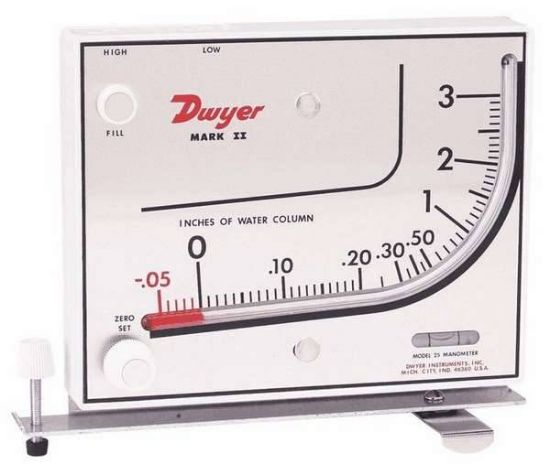
Cole-Parmer Inclined Manometer, 3 inWC
A compact inclined-vertical tube manometer with gauge fluid included, a level vial and a zero-adjust plunger. The slanted section spreads small readings over a longer scale, so low pressures are easy to read.
View This Manometer
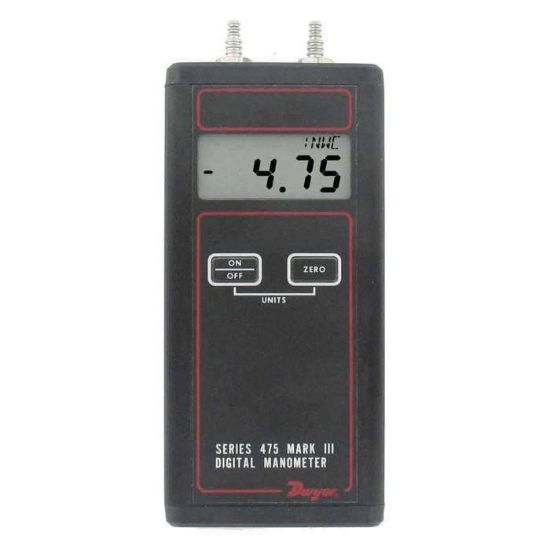
Cole-Parmer Digital Manometer, 1 inWC
A handheld digital manometer for positive, negative and differential pressure of air and natural gas, accurate to ±0.5% of full scale, with selectable units and approval for intrinsically safe use in hazardous areas.
View This Manometer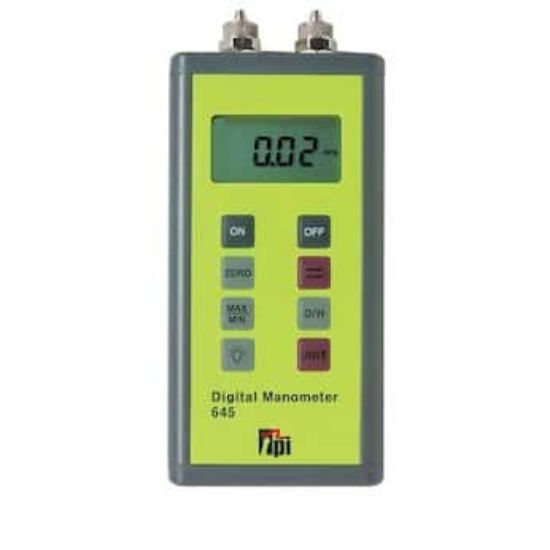
TPI 665 Dual-Input Differential Manometer
Reads ±101.5 psi (±7 bar) differential with ±0.2% full-scale accuracy and 0.01 psi resolution, switches between seven units, and logs up to 5,000 readings at intervals from one second to 24 hours.
View This Manometer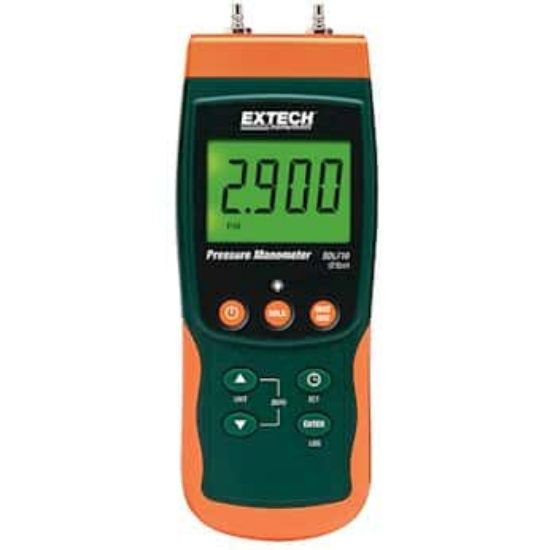
Extech SDL710 Differential Manometer Data Logger, 2.9 psi
A dual-input differential manometer that records date- and time-stamped readings continuously to an SD card in any of ten units, then exports them to a spreadsheet. Built for cleanroom, HVAC and lab monitoring.
View This Data Logger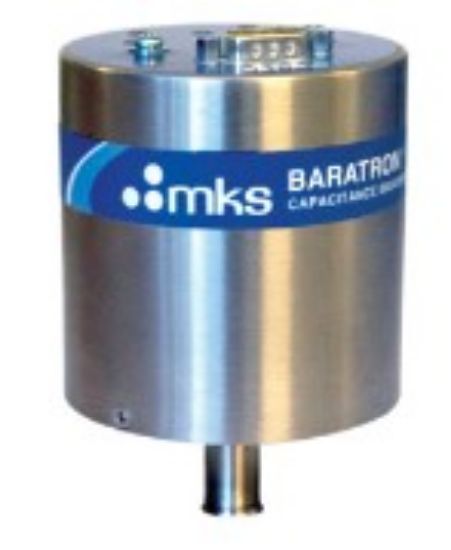
MKS Baratron Capacitance Manometer, 10 Torr Absolute
An absolute capacitance manometer for vacuum work, accurate to ±0.5% of reading rather than of full scale, with a two-wire 4 to 20 mA output for process control. Other full-scale ranges run from 1 to 25,000 Torr.
View This ManometerSee more in our manometer range, including more digital ranges and slack-tube sizes.
More Pressure And Lab Guides
kPa To PSI Pressure Converter
Convert kPa, psi, bar, inH₂O, mmHg and more, with charts and the gauge vs absolute explainer.
Open The ConverterWhat Is A Fume Hood?
Ducted vs ductless fume hoods explained, and how to choose the right one for your lab.
Read The Fume Hood GuideLaboratory Freeze Dryer Guide
How freeze dryers work under vacuum, what they cost in Australia and how to choose one.
Read The Freeze Dryer GuideManometer FAQs
What Is A Manometer Used For?
A manometer measures low pressures and pressure differences: airflow and duct pressure in HVAC, gas supply pressure, filter loading, cleanroom and fume cupboard pressure, vacuum in process equipment, and as a reference for calibrating other gauges.
What Is The Difference Between A Manometer And A Pressure Gauge?
A manometer usually measures small pressures, often with a liquid column or a sensitive digital sensor, and can read differential pressure directly. A pressure gauge typically uses a Bourdon tube or diaphragm and suits higher pressures. In parts of Europe the word manometer is used for any pressure gauge, which is why some guides treat them as the same thing.
What Is The Difference Between A Manometer And A Barometer?
A barometer measures atmospheric pressure against a vacuum, so it gives an absolute reading. A manometer measures the pressure of a system relative to the atmosphere or to a second pressure.
Is An Anemometer The Same As A Manometer?
No. An anemometer measures air speed directly. A differential manometer connected to a pitot tube can work out air velocity from the pressure difference, which is why the two often appear together in airflow testing.
How Do You Read A U-Tube Manometer?
Read the height difference between the liquid levels in the two legs, at eye level, from the bottom of the curved water surface. If the scale is zero-centred, add the rise in one leg to the fall in the other. A 10 mm difference in water is about 98 Pa.
What Liquid Is Used In A Manometer?
Water or a coloured gauge oil for low pressures, because a light liquid gives a taller, easier-to-read column. Mercury is about 13.6 times denser than water, so it was used for higher ranges, but its toxicity means most labs now use water, oil or digital instruments.
What Is A Gas Manometer?
A gas manometer is a low-range manometer, usually digital, used to check gas supply and appliance pressures. In Australia, gas appliance work is licensed work, so the instrument is used by a qualified gas fitter following the appliance data plate.
Is A Sphygmomanometer A Manometer?
In principle, yes: it is a manometer built into a blood pressure cuff, reading in mmHg. It is a medical device, though, and not covered in this guide, which is about laboratory and industrial manometers.
Not Sure Which Manometer You Need?
Tell John Morris Group what you are measuring and the pressure range, and we will match you with a liquid, digital, differential or capacitance manometer for your lab or site.
Contact UsCall 1300 501 555 or contact John Morris Group for quotation and technical support.