A fume hood is an enclosed ventilated workspace that protects laboratory personnel from hazardous chemical vapours, gases, dust, and fumes. Air is drawn through the open sash face and either exhausted outside via ducting or filtered and recirculated back into the room. Fume hoods are required in any Australian laboratory handling volatile, toxic, or odorous chemicals under AS/NZS 2243.8.
Choosing between ducted and ductless changes your installation cost, energy consumption, chemical compatibility, and long-term flexibility. This guide explains both types, when each is the right choice, and common selection mistakes.
In This Guide
How a Fume Hood Works · Ducted vs Ductless · Types of Fume Hoods · How to Choose · Common Mistakes · FAQ
Fume Hood vs Fume Cupboard
"Fume hood" and "fume cupboard" mean the same thing. "Fume hood" is the standard term in North America and most international literature. "Fume cupboard" is the traditional term in Australia, New Zealand, and the UK. The Australian Standard AS/NZS 2243.8 uses "fume cupboard".
How a Fume Hood Works
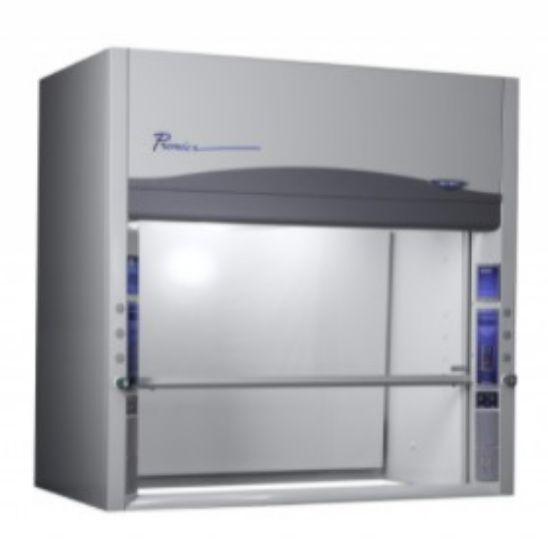
A fume hood draws air through the front opening (the sash) and across the work surface. This airflow captures vapours at the source and prevents them from reaching the operator's breathing zone.
The sash is a transparent panel (glass or polycarbonate) that slides up and down. Lowering the sash increases face velocity and improves containment. Raising it provides more working access but reduces protection.
AS/NZS 2243.8 requires an average face velocity of at least 0.5 m/s across the sash opening, with individual readings within 20% of the average. This must be tested regularly.
Ducted vs Ductless Fume Hoods
This is the most important decision when selecting a fume hood.
| Factor | Ducted | Ductless |
|---|---|---|
| How it works | Exhausts contaminated air outside via roof ducting | Filters air through carbon/HEPA and recirculates into room |
| Installation | Requires ductwork, roof penetration, blower motor | Plug-and-play, no ductwork needed |
| Chemical range | Handles virtually any chemical at any concentration | Limited to chemicals the filter can capture |
| Energy cost | High (exhausts conditioned air, HVAC must replace it) | Low (recirculates filtered air, no HVAC loss) |
| Ongoing costs | HVAC energy, annual face velocity testing | Filter replacement every 12-18 months + testing |
| Flexibility | Fixed position (tied to ductwork) | Can be relocated within the lab |
| Available at JMG | Labconco | Erlab |
Choose ducted when: You handle highly toxic, carcinogenic, or unknown chemicals. You need maximum containment. You have existing ductwork or are building a new lab.
Choose ductless when: You work with a known, consistent set of chemicals. You need flexibility to relocate the hood. Ductwork is impractical or too expensive to install. You want to reduce energy consumption.

Not sure which type you need? Call 1300 501 555 or browse our Labconco ducted hoods and Erlab ductless hoods.
Types of Fume Hoods
Bench-Top Ducted Fume Hoods
The standard laboratory fume hood. Sits on the bench, connects to external ductwork, and exhausts air to the outside. Available in widths from 3 ft to 8 ft. The Labconco Protector Premier is a widely used example, featuring a one-piece fiberglass liner for corrosion resistance and an integrated blower option.
Ductless Filtering Fume Hoods
Self-contained units that filter air through activated carbon and/or HEPA filters and recirculate clean air back into the room. No ductwork required. The Erlab Captair 321 Smart includes integrated filter saturation sensors with real-time alerts, eGuard remote monitoring, and compliance with AFNOR NF X 15-211, BS 7989, and DIN 12 927.
Compact / Benchtop Hoods
Smaller ducted hoods designed for space-constrained labs. The Labconco Fiberglass 30 is a compact benchtop option with an explosion-proof blower for flammable solvent work.
Ductless Enclosures (Large Format)
High-capacity ductless hoods for larger equipment or higher throughput work. The Labconco Paramount Ductless Enclosure offers a 4 ft working width with stackable carbon and HEPA filters.
Fume Extractor Arms (Source Capture)
Not technically fume hoods, but used alongside them for localised extraction at workstations where a full enclosure is not needed. See our guide on Nederman fume extractor arms for Australian laboratories.
How to Choose the Right Fume Hood
1. What chemicals will you handle? If the list includes highly toxic, carcinogenic, or unknown substances, a ducted hood is the only safe choice. If you work with a defined, consistent set of chemicals, a ductless hood with the correct filter type may be suitable.
2. Do you have existing ductwork? If your building already has fume hood ducting, adding another ducted hood is straightforward. If not, the cost of installing ductwork, roof penetrations, and a blower can exceed the cost of the hood itself. Ductless may be more practical.
3. What size do you need? Standard widths are 3 ft (900 mm), 4 ft (1200 mm), 5 ft (1500 mm), and 6 ft (1800 mm). Choose based on the equipment you need to fit inside and the workspace required for your procedures.
4. Do you need to relocate it? Ducted hoods are permanently installed. Ductless hoods can be moved within or between rooms. If your lab layout may change, ductless provides more flexibility.
5. Energy and sustainability considerations. A single ducted fume hood can consume as much energy as three average Australian homes because it exhausts conditioned air 24/7. Ductless hoods recirculate filtered air, offering significant energy savings.
6. Compliance requirements. All fume hoods in Australian laboratories must comply with AS/NZS 2243.8. Face velocity testing must be performed regularly. A Labconco Guardian Airflow Monitor provides continuous face velocity monitoring to verify ongoing compliance. Both ducted and ductless hoods must meet this standard when properly installed and maintained.
Common Mistakes When Selecting a Fume Hood
Most Common Mistake
Using a ductless hood for chemicals it cannot filter. Not all chemicals can be captured by activated carbon. If you change chemicals without checking filter compatibility, operators are exposed to unfiltered vapours. Always verify your chemical list against the filter manufacturer's compatibility data before use.
- Storing chemicals inside the hood: A fume hood is a workspace, not a storage cabinet. Bottles and containers inside the hood disrupt airflow patterns and reduce containment effectiveness.
- Working with the sash fully open: Face velocity drops as the sash opens wider. For maximum protection, work with the sash at the lowest practical height. Most hoods are designed to operate at a sash height of 450 to 500 mm.
- Skipping face velocity testing: AS/NZS 2243.8 requires regular testing. Without it, you have no way to know if the hood is still providing adequate containment.
- Placing the hood near doors or high-traffic areas: Cross-draughts from doors, air conditioning vents, and foot traffic disrupt the airflow curtain and reduce containment. Position the hood away from these disturbances.
Related Guides
Nederman Fume Extractor Arms Guide · What Is Viscosity? · How to Clean Lab Glassware
Frequently Asked Questions
What is the difference between a fume hood and a fume cupboard?
They are the same thing. "Fume hood" is the international term. "Fume cupboard" is used in Australia, New Zealand, and the UK. The Australian Standard AS/NZS 2243.8 uses "fume cupboard".
What is the difference between ducted and ductless fume hoods?
A ducted fume hood exhausts contaminated air outside through ductwork. A ductless fume hood filters air through carbon and HEPA filters and recirculates clean air back into the room. Ducted handles any chemical but costs more to install and run. Ductless is flexible and energy-efficient but limited to chemicals the filter can capture.
What face velocity does AS/NZS 2243.8 require?
An average of at least 0.5 m/s across the fume hood face, with individual readings within 20% of the average. This must be tested regularly to verify ongoing compliance.
How often should fume hood filters be replaced?
For ductless hoods, filter life depends on usage and chemicals handled. Typical replacement is every 12 to 18 months. Erlab ductless hoods include integrated sensors that monitor filter saturation in real time and alert when replacement is needed.
Can I use a fume extractor arm instead of a fume hood?
Fume extractor arms provide open source capture, not enclosed containment. They are suitable for light fume extraction at satellite workstations but do not replace a fume hood for work with toxic, volatile, or carcinogenic chemicals. Many labs use both. See our Nederman extractor arm guide.
How much energy does a ducted fume hood use?
A single ducted fume hood operating 24/7 can consume as much energy as three average Australian homes because it continuously exhausts conditioned air. Ductless hoods recirculate filtered air, eliminating this energy loss.
Where can I buy fume hoods in Australia?
John Morris Group supplies Labconco ducted fume hoods and Erlab ductless fume hoods across Australia and New Zealand with local installation support, commissioning, and face velocity testing. Call 1300 501 555 or browse our fume hoods and cupboards online.
Need Help Selecting a Fume Hood?
Our team helps Australian labs choose between ducted and ductless fume hoods based on your chemical requirements, lab layout, and compliance needs.
Call 1300 501 555 or browse our Labconco and Erlab ranges, or view our full fume hoods and cupboards category.