What Is A Ball Valve? Types, Materials And How To Choose One
A ball valve uses a rotating, hollow ball to start, stop or divert the flow of a liquid or gas with a simple quarter turn.
From general-purpose brass isolation valves to sanitary and high-vacuum designs, the right ball valve depends on your pressure, material compatibility and flow configuration requirements.
How Does A Ball Valve Work?
A ball valve controls flow using a hollow, perforated ball mounted inside the valve body. Turning the handle a quarter turn (90°) rotates the ball so its bore either lines up with the pipe, letting fluid or gas pass straight through, or sits perpendicular to it, sealing the line off completely.
Because it only takes a quarter turn to fully open or close, a ball valve is faster to operate than a gate or globe valve, and it gives a tighter, more reliable shut-off since the ball seats squarely against the seals in both positions.
What Is A Ball Valve?
A ball valve is a quarter-turn valve that uses a rotating ball with a through-bore to start, stop or isolate the flow of a liquid or gas. When the bore is aligned with the pipe, flow passes through unrestricted; rotate the handle 90° and the solid face of the ball blocks the line, sealing it off.
Ball valves come in 2-way configurations for straight-through on/off isolation, and 3-way configurations for diverting or mixing flow between two lines. Materials range from general-purpose brass and stainless steel through to PVC, polypropylene, PTFE-lined and sanitary Tri-Clamp designs for aggressive, hygienic or high-purity fluids.
Ball valves are often paired with flow measurement in a fluid control system see our guide to flow meters for how the two work together.
Common Ball Valve Applications
- •Isolating pumps, tanks and instrumentation for maintenance
- •Diverting or mixing process fluid lines (3-way)
- •Sanitary and hygienic fluid transfer (Tri-Clamp)
- •High-vacuum and gas line isolation
- •General plant and laboratory fluid shut-off
2-Way Or 3-Way Ball Valve — Which Do You Need?
Start with what the valve needs to do — simple isolation, or diverting and mixing flow — then confirm material, pressure and connection type.
Choose A 2-Way Ball Valve If
- •You need simple on/off isolation, not diversion
- •The line only ever needs to be fully open or fully closed
- •You are isolating a pump, tank or instrument for maintenance
- •A compact, lower-cost valve is the priority
Choose A 3-Way Ball Valve If
- •You need to divert flow between two outlet lines
- •You need to mix or blend two inlet streams
- •You want to switch a line's destination without extra fittings
- •Your process needs L-port or T-port flow routing
Ask Before Buying
- •What is the maximum operating pressure and temperature?
- •Will the valve contact aggressive chemicals or need to be sanitary?
- •What connection type does the pipework use (BSP, NPT, flanged, Tri-Clamp)?
- •Do you need precise throttling, or just on/off isolation?
2-Way Vs 3-Way Ball Valve At A Glance
If you want a quick answer, this table shows where a 2-way ball valve is usually the better choice and where a 3-way valve earns its extra cost and complexity.
| Criteria | 2-Way Ball Valve | 3-Way Ball Valve | Better Choice |
|---|---|---|---|
| Primary Function | ✓ Simple on/off isolation | – Diverting or mixing between lines | Depends On Application |
| Number Of Ports | 2 ports, straight-through | 3 ports, L-port or T-port design | Depends On Application |
| Pump Or Tank Isolation | ✓ Ideal, purpose-built for this | – Unnecessary complexity for simple isolation | 2-Way |
| Flow Diversion Or Blending | – Not designed for this | ✓ Purpose-built for diverting and mixing | 3-Way |
| Installation Complexity | ✓ Fewer fittings, simpler plumbing | – More connections and planning required | 2-Way |
| Typical Cost | ✓ Lower cost | – Higher cost (extra port and machining) | 2-Way |
What Materials Are Ball Valves Made From?
Brass ball valves: The most common general-purpose choice for water, air and compressed gas lines, offering good pressure handling and machinability at a moderate cost. Not ideal for highly corrosive or high-purity fluids.
Stainless steel (316) ball valves: Higher corrosion resistance for chemical processing, food-grade, outdoor and marine use, with a wider pressure and temperature range than brass or plastic bodies.
PVC and polypropylene ball valves: Lightweight and corrosion-resistant, well suited to chemical drainage, irrigation and laboratory fluid lines, but limited in maximum temperature and pressure compared to metal bodies.
Sanitary and PTFE-lined ball valves: Tri-Clamp/hygienic fittings and PTFE-lined bores support pharmaceutical, food and beverage sanitary transfer and highly aggressive chemical compatibility where product contact matters.
High-vacuum ball valves: ISO-KF flanged designs are used to isolate vacuum lines and chambers in laboratory and process-instrumentation systems, where a standard threaded or flanged valve body would not hold vacuum.
Why Ball Valves Are Widely Used For Flow Control
1. Fast, Reliable Shut-Off
A quarter turn is all it takes to move from fully open to fully closed, which is quicker and more repeatable than multi-turn valve types.
2. Tight Sealing When Closed
The ball seats squarely against the valve seals in both open and closed positions, giving a dependable, low-leakage shut-off.
3. Low Maintenance
With few moving parts and a simple quarter-turn mechanism, ball valves generally require less servicing than gate or globe valves.
4. Broad Material Compatibility
From brass and stainless steel through to PVC and PTFE-lined bodies, a ball valve is available for almost any fluid or gas compatibility requirement.
5. Wide Pressure And Temperature Range
Ball valves are available from low-pressure laboratory lines through to high-pressure, high-temperature industrial process systems.
6. Minimal Flow Restriction When Open
Full-bore ball valve designs create very little pressure drop when fully open, keeping flow close to unrestricted.
Do Ball Valves Have A Flow Direction?
Most standard 2-way ball valves are bidirectional, meaning flow can pass through in either direction because the bore and seals are symmetrical. This makes them straightforward to install without worrying about orientation.
3-way ball valves are typically directional. An L-port valve routes flow between adjacent ports only, while a T-port valve can connect all three ports simultaneously or divide flow between two outlets — the correct handle position depends on the specific port configuration.
Always check the manufacturer's flow arrow or port diagram before installing a 3-way valve, and confirm bidirectional ratings with the datasheet for critical or high-pressure applications.
Ball Valves At John Morris Group
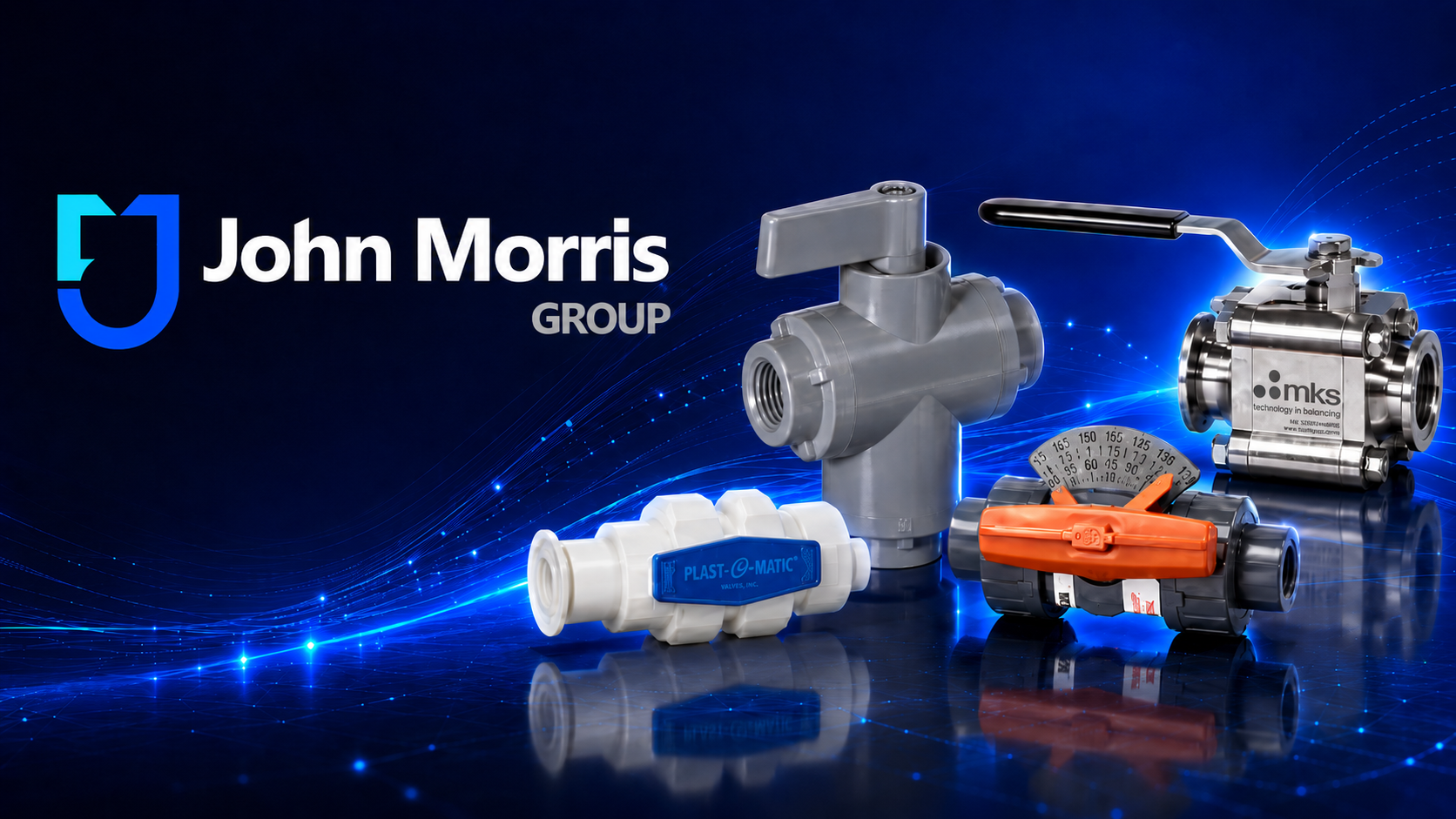
John Morris Group supplies ball valves for metering, sanitary process transfer, general fluid control and high-vacuum applications.
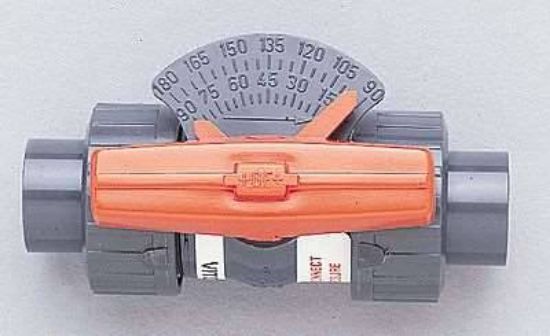
GF Signet PVC Metering Ball Valve, 1/2" NPTF
True-union metering ball valve with precise 180° flow control calibrated in 5° increments, for fine-tuned throttling rather than simple on/off duty.
Browse This Ball Valve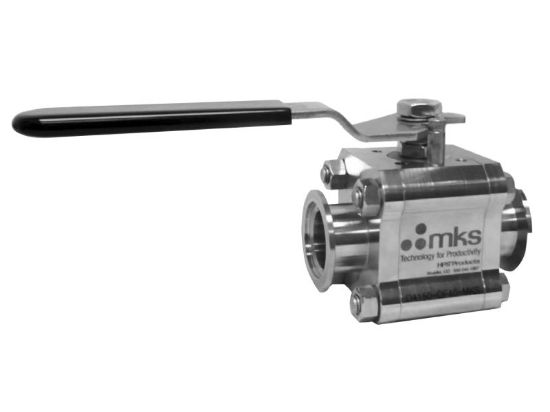
MKS High Vacuum Ball Valve, 2-Way, NW40 Port
Manually operated high-vacuum ball valve with an NW40 port, ISO-KF flange and self-cleaning seat design, built to isolate vacuum lines and chambers.
Browse This Ball Valve
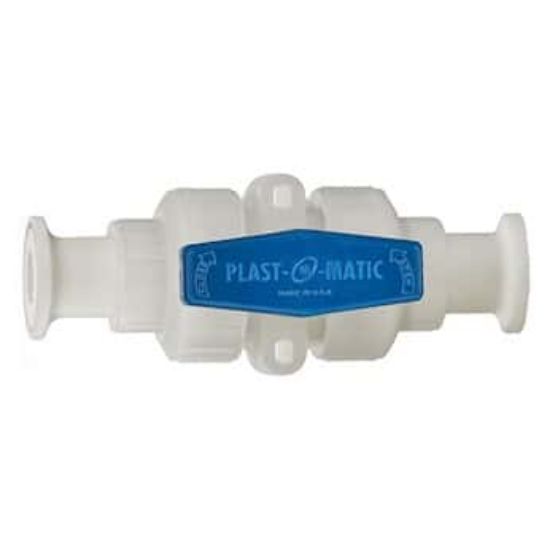
Plast-O-Matic 2-Way Sanitary Ball Valve, PP, 1.5"
Polypropylene sanitary ball valve with a mirror-polished, concentric ball and Tri-Clamp connections for leakproof, hygienic fluid transfer.
Browse This Ball Valve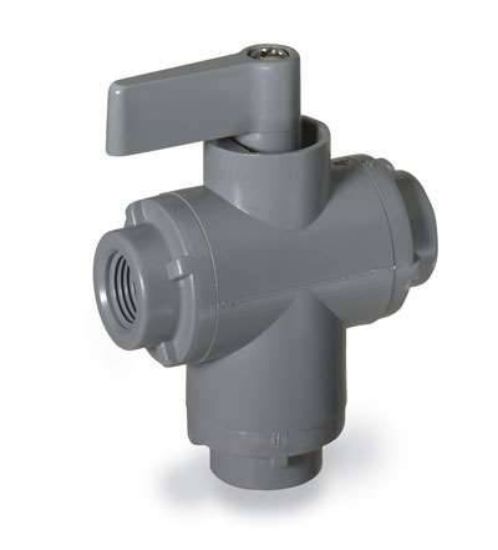
VWR 3-Way Ball Valve, 1/8" NPT(F), PVC
PVC 3-way ball valve with Buna-N seals, rated to 125 psi and 140°F, suited to general laboratory and industrial fluid diversion.
Browse This Ball ValveExplore More Fluid Control Resources
Ball valves work alongside flow measurement and pump selection in a complete fluid control system. See how these related topics connect.
Flow Meter Guide
Learn how flow meters measure liquid and gas flow, and how they pair with ball valves in a fluid control setup.
Read The Flow Meter GuideWhat Is A Peristaltic Pump?
Compare peristaltic pumps with other fluid handling equipment and see how they fit into a broader fluid control system.
Read The Pump GuideMasterflex Peristaltic Pump Selection Guide
See how drive, pump head and tubing selection work together for reliable fluid transfer alongside your valve setup.
Read The Selection GuideBall Valve FAQs
What Is A Ball Valve?
A ball valve is a quarter-turn valve that uses a rotating, hollow ball to start, stop or divert the flow of a liquid or gas. Rotating the handle 90° moves the ball's bore in or out of line with the pipe.
How Does A Ball Valve Work?
Turning the handle a quarter turn rotates a perforated ball inside the valve body. When the bore lines up with the pipe the valve is open; when it is perpendicular to the pipe the solid side of the ball blocks flow and the valve is closed.
What Is The Difference Between A 2-Way And A 3-Way Ball Valve?
A 2-way ball valve has two ports and is used for simple straight-through on/off isolation. A 3-way ball valve has three ports, arranged as an L-port or T-port, and is used to divert flow between two lines or mix two inlet streams.
Are Ball Valves Directional?
Most 2-way ball valves are bidirectional and can be installed either way round. 3-way valves are typically directional, since flow routing depends on the specific L-port or T-port configuration — always check the manufacturer's flow diagram before installing.
What Materials Are Ball Valves Made From?
Common ball valve materials include brass and stainless steel for general industrial use, PVC and polypropylene for lightweight and chemical-resistant applications, and PTFE-lined or sanitary Tri-Clamp designs for aggressive or high-purity fluids.
Can A Ball Valve Be Used To Control Or Throttle Flow Rate?
A standard ball valve is designed for fully open or fully closed operation — partially opening it can cause turbulence and accelerated wear on the seat and ball. Purpose-built metering ball valves are the exception: they add a calibrated handle stop (often in 5° increments) so the ball position can be repeated accurately, making them a genuine option for adjustable flow control rather than just on/off isolation.
How Long Do Ball Valves Last?
Service life depends on material, fluid compatibility and cycle frequency, but well-matched ball valves used within their pressure and temperature rating commonly handle tens of thousands of open/close cycles before the seats need replacement.
What Is The Difference Between Full Bore And Reduced Bore Ball Valves?
A full-bore ball valve has a bore diameter matching the pipe's internal diameter, giving minimal flow restriction and pressure drop. A reduced-bore valve has a smaller bore, which is more compact and often lower cost but restricts flow slightly more when open.
Need Help Choosing The Right Ball Valve?
Talk to John Morris Group about ball valves for sanitary, general industrial and high-vacuum fluid control applications in your laboratory or facility.
Contact UsCall 1300 501 555 or contact John Morris Group for quotation and technical support.