Precise Volume Measurement, Without The Guesswork
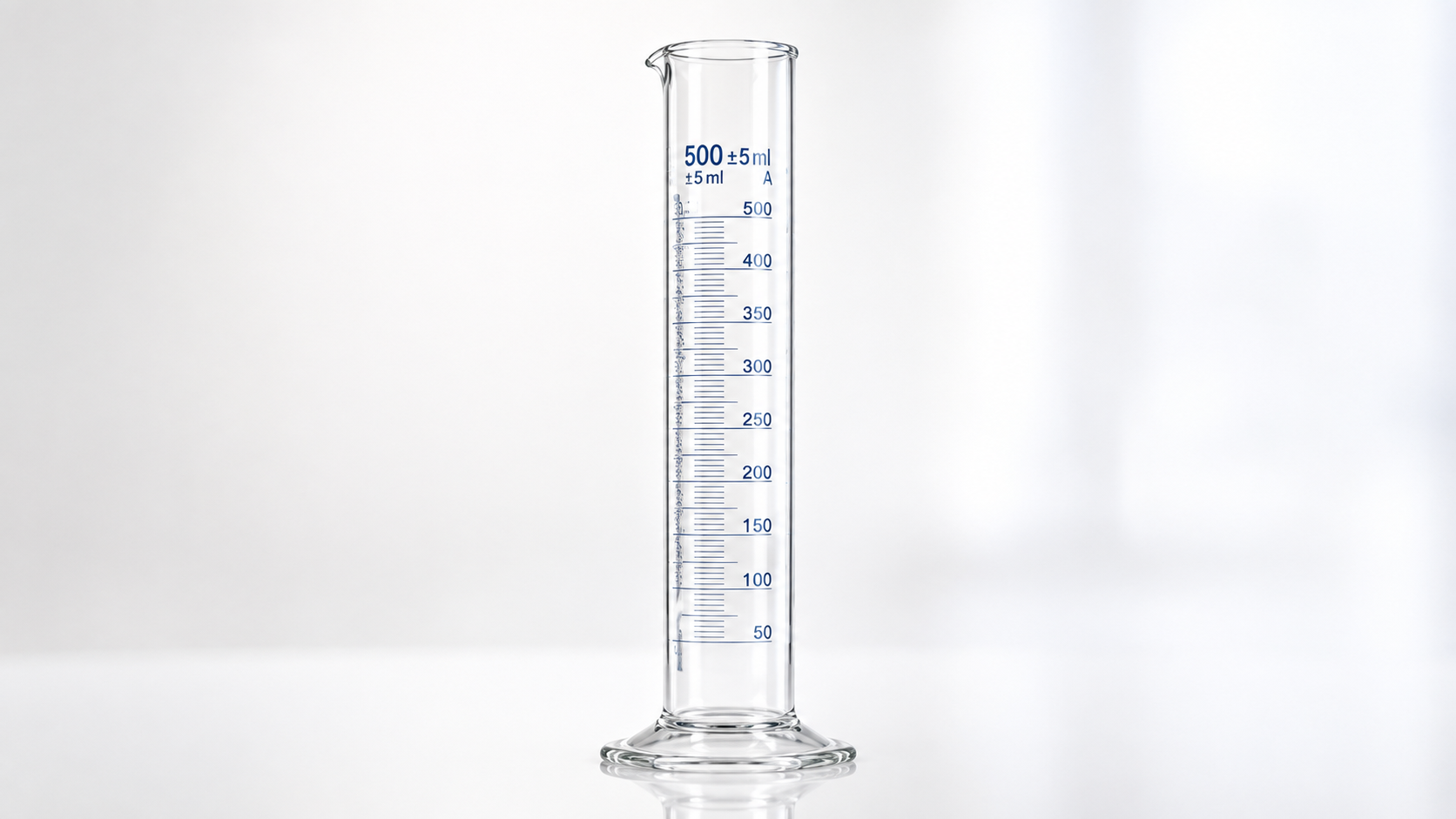
A graduated cylinder, also called a measuring cylinder, is a tall, narrow glass or plastic vessel used to measure a specific volume of liquid with far greater accuracy than a beaker.
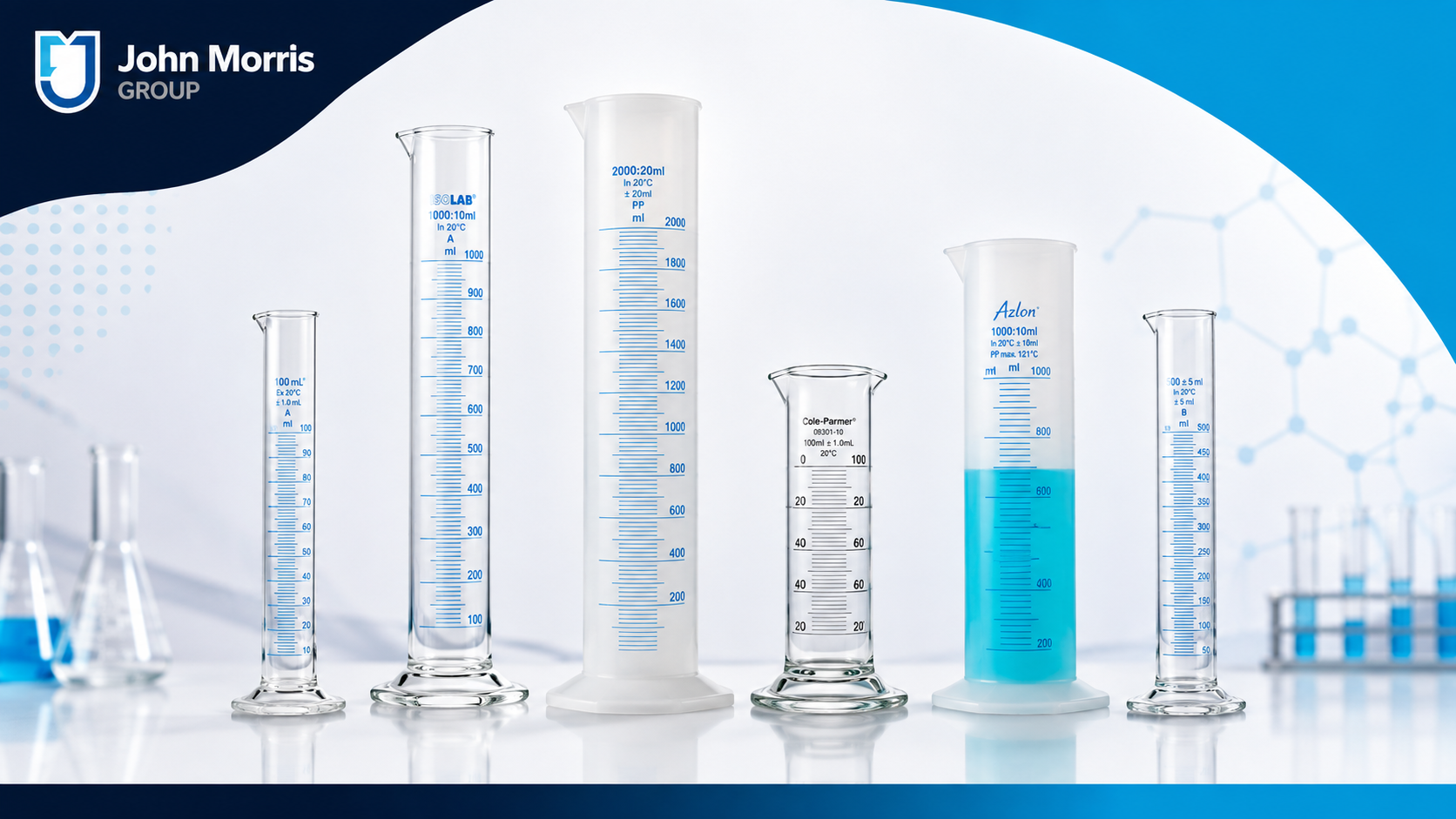
Available in Class A and Class B tolerances, tall and low (squat) forms, and glass or polypropylene construction, the right graduated cylinder depends on the accuracy, chemical compatibility and volume range your work requires.
How Accurate Is A Graduated Cylinder?
A graduated cylinder is accurate to within its stated tolerance class, either Class A (tighter tolerance, often supplied with a calibration certificate) or Class B (wider tolerance, more economical). Reading the volume correctly, at eye level against the bottom of the meniscus, matters just as much as the cylinder's own tolerance rating.
A graduated cylinder is more accurate than a beaker, whose graduations are only approximate, but less accurate than a volumetric flask, which is calibrated to a single exact volume rather than a full graduated scale.
What Is A Graduated Cylinder?
A graduated cylinder, also called a measuring cylinder, is a tall, narrow laboratory vessel marked with graduation lines along its length, used to measure and transfer a specific volume of liquid. Its narrow diameter relative to its height means each graduation represents a smaller, more precise increment of volume than the wide, tapered markings on a beaker.
Graduated cylinders are supplied in tall form and low (squat) form, in borosilicate glass or polypropylene/PMP plastic, and calibrated to either Class A or Class B tolerance. Borosilicate glass tolerates a broader range of chemicals and temperature swings than plastic, though no single material resists every reagent: hydrofluoric acid, hot concentrated phosphoric acid and strong alkaline solutions all attack glass, so check a chemical-compatibility chart before working with anything unusual. Plastic cylinders resist breakage and cost less, which suits routine, non-critical measurement.
A beaker's graduations are only ever an approximate guide, so most labs reach for a graduated cylinder whenever an accurate liquid volume matters. See our guide to volume beakers for exactly where the two differ and when a beaker is still the right choice.
Common Graduated Cylinder Applications
- •Routine reagent preparation where volumetric-flask accuracy isn't required
- •Measuring liquids used in titration preparation and general dilutions
- •Finding a solid object's volume by liquid displacement
- •General dispensing and liquid transfer between vessels
- •Quality control and teaching lab volume checks
Graduated Cylinder Or Volumetric Flask, Which Do You Need?
Start with whether you need to measure a range of volumes or one single exact amount, then confirm the tolerance class and calibration type you need.
Choose A Graduated Cylinder If
- •You need to measure a range of different volumes, not just one fixed amount
- •Reasonable accuracy matters, but a Class A volumetric flask's tolerance is overkill
- •You are transferring or dispensing a measured volume of liquid
- •Budget and everyday durability matter as much as precision
Choose A Volumetric Flask Instead If
- •You need to prepare one single exact volume of solution
- •The task is a calibration, standard solution or analytical procedure needing the tightest tolerance
- •You only ever need that one fixed volume, not a graduated range
- •The extra cost of a Class A volumetric flask is justified by the accuracy required
Ask Before Buying
- •Do you need Class A (tighter tolerance, often certified) or is Class B accurate enough?
- •Is the cylinder calibrated To Contain (TC) or To Deliver (TD), and does that match how you'll use it?
- •Will it contact aggressive chemicals or high temperatures, favouring glass over plastic?
- •What is the smallest cylinder that comfortably holds your typical volume, since smaller cylinders read more precisely?
Beaker Vs Graduated Cylinder Vs Volumetric Flask At A Glance
These are the three most common liquid-volume vessels in a laboratory. This table shows where each is the stronger choice, and where the differences matter most.
| Criteria | Beaker | Graduated Cylinder | Volumetric Flask | Better Choice |
|---|---|---|---|---|
| Accuracy Class Available | ✗ No Class A/B rating, indicative only | ✓ Class A or Class B, to ISO 4788 | ✓ Class A or Class B; Class A offers the tightest tolerance | Volumetric Flask |
| Best For | General mixing, rated heating, rough volumes | ✓ Measuring a range of volumes accurately | One exact volume for a standard solution | Depends On Task |
| Graduation Marks | Few, widely spaced, approximate | ✓ Many, closely spaced along the full scale | One etched fill line only | Graduated Cylinder |
| Safe To Stir Or Heat | ✓ Wide mouth; suitable for stirring and, when made and rated for it, heating | ✗ Narrow and tall, not for stirring or heat | ✗ Narrow neck, not for stirring or heat | Beaker |
| Typical Cost | ✓ Lowest cost | Moderate cost | Higher cost, especially Class A | Beaker |
What Types Of Graduated Cylinder Are There?
Tall form cylinders: The standard shape for most laboratory work, with a narrow diameter relative to height that spreads each graduation further apart for a more precise reading. A hexagonal or ribbed foot helps prevent rolling on the bench.
Low form (squat) cylinders: A shorter, wider base gives a lower centre of gravity and better stability than a tall form cylinder, at the cost of slightly less precise graduation spacing. Useful where tip-over risk is a concern.
Borosilicate glass cylinders: Offer excellent optical clarity, dimensional stability and resistance to thermal shock, plus resistance to most laboratory chemicals, though compatibility still depends on the specific reagent (see the note above on hydrofluoric acid and strong alkalis).
Polypropylene (PP) and PMP cylinders: Lightweight and far more break-resistant than glass, a common choice for teaching labs, fieldwork and routine, non-critical measurement where cost and durability outweigh chemical resistance.
Class A cylinders: Manufactured and tested to a tighter tolerance, often supplied with a calibration certificate and fused-in serial number for traceability, suiting analytical or calibration-critical work.
Class B cylinders: A wider, but still clearly defined, tolerance at a lower cost, well suited to routine measurement where Class A precision isn't required.
Why Accurate Volume Measurement Matters
1. Genuine Accuracy For Everyday Work
Graduations reflect a tested tolerance rather than a beaker's rough estimate, so results are meaningfully more reliable.
2. Repeatable Results
Consistent volumes for dilutions, reagent preparation and quality control checks depend on a vessel that gives the same reading every time.
3. A Choice Of Tolerance Grade
Class A for calibration-critical work, Class B for routine measurement at a lower cost, so you only pay for the accuracy you need.
4. Broad Material Compatibility
Borosilicate glass or polypropylene lets you match the cylinder to most chemical and temperature needs, though always check compatibility for unusual reagents.
5. Simple, No-Power Measurement
You get an accurate volume reading with no electricity, calibration equipment or extra setup, just the vessel itself.
6. Wide Volume Range Coverage
Available from a few millilitres to several litres, matching almost any lab, teaching or QC task.
How Do You Read A Graduated Cylinder Accurately?
Place the cylinder on a flat, level surface and bring your eye level with the liquid surface rather than looking down or up at it. Viewing the meniscus from an angle introduces parallax error, which is one of the most common sources of reading mistakes.
For most clear, water-based liquids the meniscus curves downward, so read the volume at the bottom of that curve. Dark or opaque liquids can hide the true curve; a common practical convention is to read the top of the liquid surface instead, though always follow your lab's specified method or the instrument's own documentation where one applies.
After pouring, give the liquid a few moments to settle and drain fully down the cylinder walls before taking a reading. Choose the smallest cylinder that safely accommodates the required volume: a cylinder sized for that range usually has finer graduations and gives a lower relative uncertainty than measuring the same volume in an oversized one.
Graduated Cylinders At John Morris Group
John Morris Group supplies graduated cylinders across Class A and Class B tolerances, glass and polypropylene construction, and a wide range of volumes.
Cole-Parmer Class A Graduated Cylinder, 100 mL
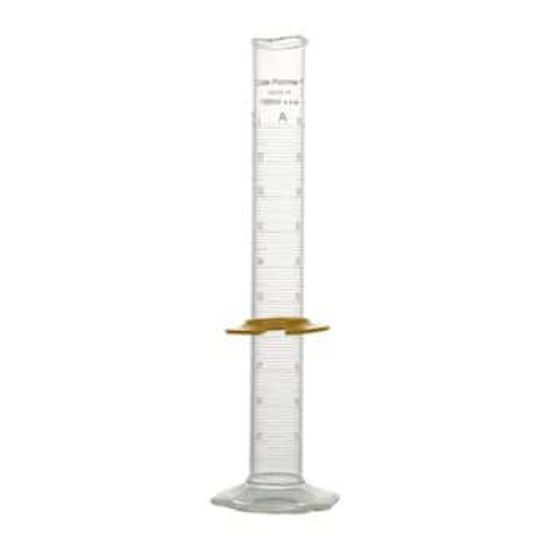
Class A borosilicate glass cylinder calibrated to contain (TC), supplied with a certificate of calibration and fused-in serial number for full traceability.
Browse This Cylinder
ISOLAB Measuring Cylinder, 1000 mL, Tall Form Glass, Class A
Large-capacity Class A borosilicate glass cylinder with a glass base for stability, blue enamel graduations and batch certification to DIN EN ISO 4788.
Browse This Cylinder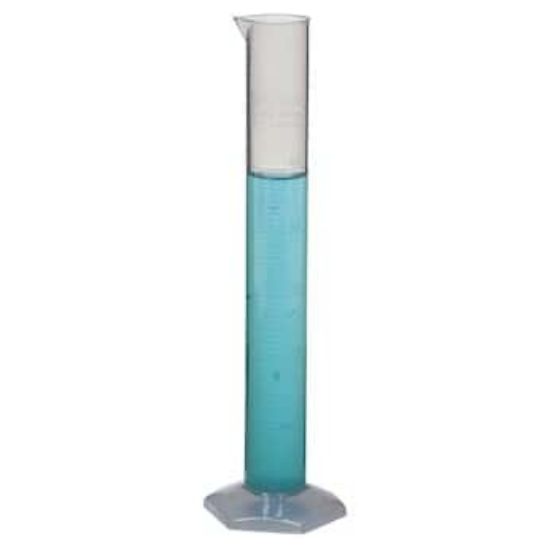
Cole-Parmer Graduated Cylinder, PP, 2000 mL, Economical
Lightweight polypropylene cylinder for large-volume general lab use, with molded graduations calibrated to ISO 6706 and better break resistance than glass.
Browse This Cylinder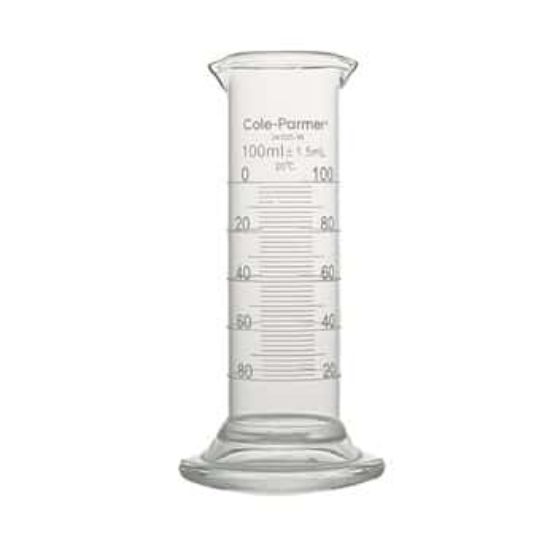
Cole-Parmer Low-Form Graduated Glass Cylinder, 100 mL
Low-profile glass cylinder calibrated to deliver (TD), with a double metric scale and two pouring spouts for added stability on the bench.
Browse This Cylinder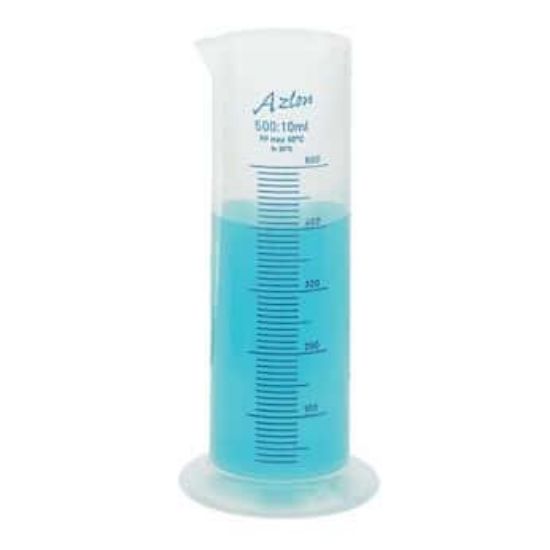
Azlon Squat Form PP Graduated Cylinder, 1000 mL
Squat-base polypropylene cylinder with an anti-suction, self-draining base for a lower centre of gravity and easier cleaning between uses.
Browse This Cylinder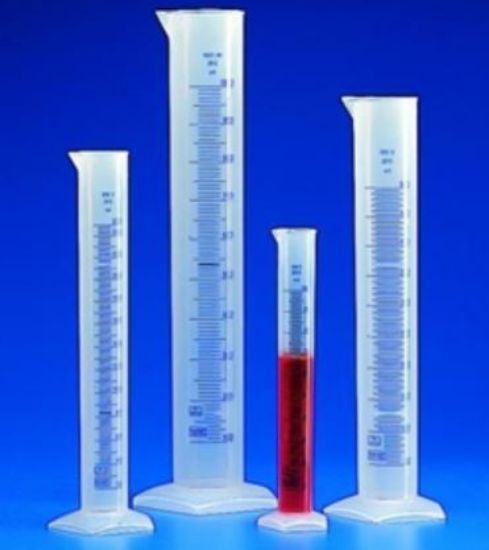
Kartell Measuring Cylinder, Tall Form, Class B, 500 mL
Mid-range Class B polypropylene cylinder to ISO 6706 tolerance, a cost-effective option for routine, non-analytical volume measurement.
Browse This CylinderExplore More Laboratory Glassware Resources
A graduated cylinder is one piece of a broader glassware toolkit. See how it fits alongside beakers, flasks and glass selection more generally.
What Is A Volume Beaker?
See exactly how a beaker's approximate graduations differ from a graduated cylinder's precise scale.
Read The Beaker GuideErlenmeyer Flask / Conical Flask Guide
Learn the types and uses of conical flasks, another core piece of general laboratory glassware.
Read The Conical Flask GuideComplete Guide To Laboratory Glassware
A broader look at selecting, using and maintaining glassware to Australian laboratory standards.
Read The Glassware GuideGraduated Cylinder FAQs
What Is A Graduated Cylinder Used For?
A graduated cylinder is used to measure and transfer a specific volume of liquid with greater accuracy than a beaker, commonly for preparing reagents, dilutions, titration setup and general laboratory liquid transfer.
How Do You Read The Meniscus On A Graduated Cylinder?
Hold the cylinder level, bring your eye to the same height as the liquid surface, and read the volume at the bottom of the curved meniscus for clear liquids. For dark or opaque liquids, a common convention is to read the top of the surface instead, after waiting a moment for the liquid to settle, following your lab's specified method where one applies.
What Is The Difference Between A Graduated Cylinder And A Beaker?
A graduated cylinder's narrow, tall shape and closely spaced graduations give a meaningfully more accurate volume reading than a beaker, whose wide shape and widely spaced markings are only intended as an approximate guide.
Is A Graduated Cylinder More Accurate Than A Volumetric Flask?
No. A volumetric flask is calibrated to a single, exact volume marked by one etched line, giving the tightest tolerance of the three vessels. A graduated cylinder trades some of that precision for the ability to measure a full range of volumes on one scale.
What Is The Difference Between A Class A And Class B Graduated Cylinder?
Class A cylinders are manufactured and tested to a tighter tolerance, often supplied with a calibration certificate, and suit analytical or calibration-critical work. Class B cylinders have a wider, but still clearly defined, tolerance and are a more economical choice for routine measurement.
What Does "To Contain" And "To Deliver" Mean On A Graduated Cylinder?
"To Contain" (TC) means the cylinder holds the stated volume when filled to the mark. "To Deliver" (TD) means the cylinder dispenses the stated volume when poured out, allowing for the thin film of liquid that clings to the glass afterwards. Check which calibration your task needs before relying on a reading.
Can A Graduated Cylinder Be Used To Find The Volume Of A Solid Object?
Yes. Partly filling a graduated cylinder with liquid, recording the level, then lowering in a solid object that doesn't dissolve or react with the liquid and recording the new, higher level lets you calculate the object's volume from the difference, a technique known as liquid displacement.
Why Are Graduated Cylinders Tall And Narrow Instead Of Wide Like A Beaker?
The tall, narrow shape means a given volume change corresponds to a larger, easier to read movement along the scale, which is what makes a graduated cylinder more accurate than a wider vessel. The trade-off is a higher centre of gravity, so tall cylinders should be handled carefully and stored on a stable, flat surface.
Is A Graduated Cylinder The Same As A Measuring Cylinder?
Yes. "Graduated cylinder" and "measuring cylinder" describe the same piece of glassware: "graduated" refers to the etched scale marks, "measuring" refers to its function. "Graduated cylinder" is more common in the US and in most international suppliers' listings, while "measuring cylinder" is the more traditional term in Australia and the UK. Either name refers to the identical product.
Need Help Choosing The Right Graduated Cylinder?
Talk to John Morris Group about graduated cylinders, beakers and volumetric flasks for your laboratory, teaching or quality control needs.
Contact UsCall 1300 501 555 or contact John Morris Group for quotation and technical support.