What Is A Burette? Types, Titration Steps And How To Use One
A burette is a graduated glass or digital instrument used to dispense a precisely measured, variable volume of liquid, most commonly the titrant in a titration.
This guide covers the main types, a full step-by-step titration method, how to read one accurately, the mistakes that most often throw off a result, and how to choose between manual glass, digital and automatic formats.
What Is A Burette Used For?
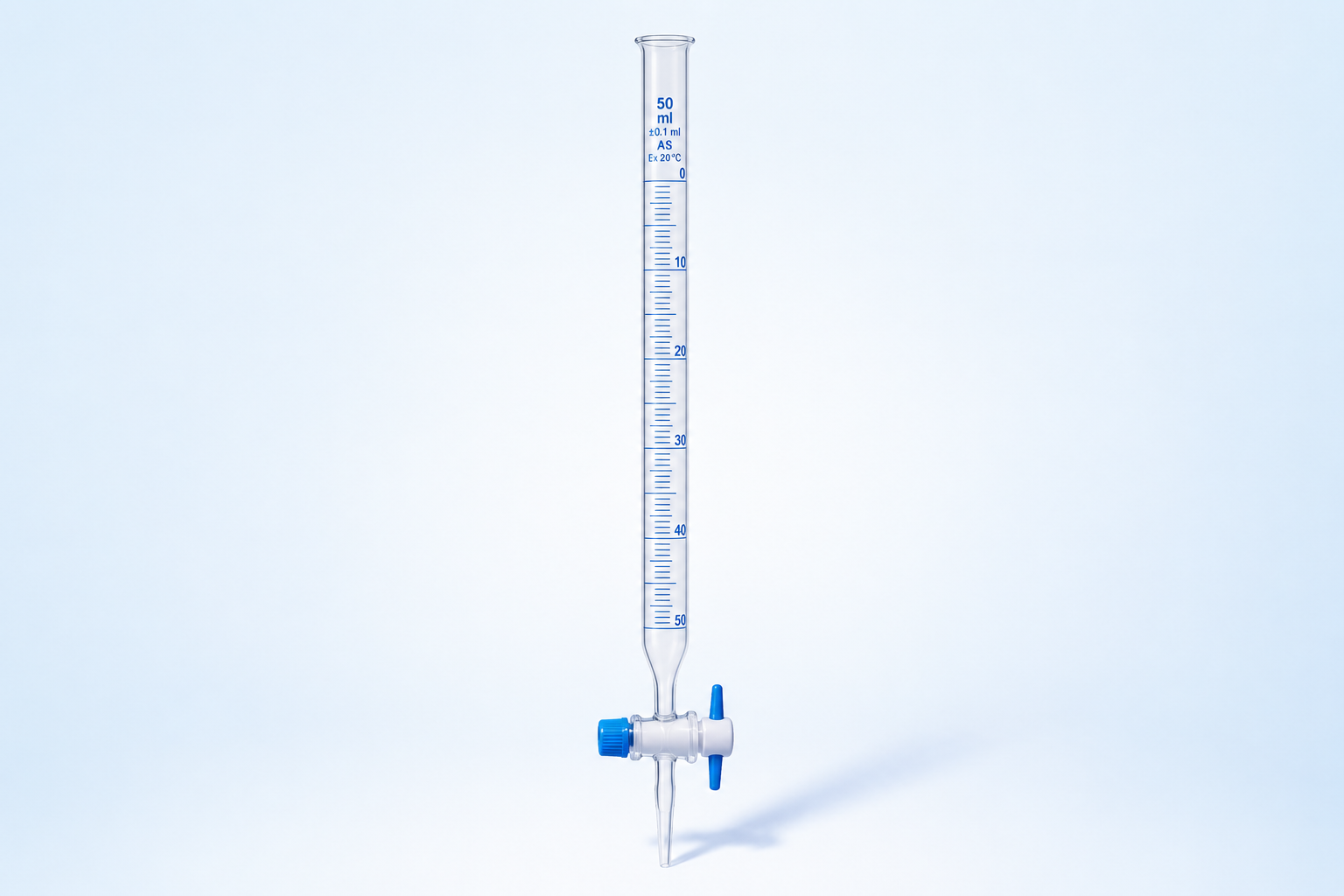
A burette is a long, graduated tube with a stopcock or valve at the base, built to dispense liquid drop by drop while you track exactly how much has been released. Unlike a pipette, which delivers one fixed volume, a burette lets you stop at any point and read off precisely how much liquid was used.
That makes it the standard tool for titration: adding a solution of known concentration (the titrant) to another solution until the reaction reaches its endpoint. Burettes are also used more broadly wherever a lab needs to dispense a precise, variable volume rather than a fixed one.
What Is A Burette?
A burette is a precision volumetric instrument, most often borosilicate glass, made up of a long graduated tube, a stopcock or valve to control flow, and a tapered tip that delivers liquid one drop at a time. Graduations run from zero at the top to the full capacity at the bottom, so the dispensed volume is the difference between an initial and a final reading.
Burettes are manufactured to recognised tolerance classes, most commonly Class A and Class B, and are usually made from borosilicate glass for its chemical resistance and dimensional stability. Digital and automatic formats replace manual stopcock control with an electronic display or a self-zeroing reservoir, cutting down on operator-dependent reading error.
A burette is almost never used alone: it is paired with a flask, usually a conical flask, that holds the solution being titrated. See our Erlenmeyer flask guide for how the two work together in a titration setup.
Common Burette Applications
- •Acid-base, redox and complexometric titrations
- •Standardising reagent solutions to a known concentration
- •Quality control testing in food, beverage and environmental labs
- •Teaching and undergraduate chemistry practicals
- •Any task needing a precise, variable liquid volume, not a fixed one
Manual Glass Or Digital Burette, Which Do You Need?
Start with how much accuracy and repeatability your titrations demand, then weigh that against budget and how many people will be reading the burette.
Choose A Manual Glass Burette If
- •You run routine or teaching titrations on a standard budget
- •Your team is trained to read a meniscus accurately
- •You want a simple instrument with no batteries or electronics
- •Class A precision is enough for your reporting requirements
Choose A Digital Or Automatic Burette If
- •You run high volumes of repeat titrations and want reading error removed
- •Multiple operators need consistent, reproducible results
- •You need fine-resolution readings or direct mounting on a reagent bottle
- •A higher upfront cost is acceptable for lower ongoing operator error
Ask Before Buying
- •Does your method require Class A tolerance, or is Class B sufficient?
- •What volume range and graduation interval do you need, including whether a micro burette suits small-volume work better than a standard 50 mL size?
- •Is the titrant compatible with a PTFE stopcock and glass, or does it need a different valve material?
- •Would a Schellbach stripe make manual reading noticeably easier for your team?
Manual Glass Vs Digital Vs Automatic At A Glance
None of the three formats is universally better. This table shows where each one usually earns its place on the bench.
| Criteria | Manual Glass | Digital | Automatic | Better Choice |
|---|---|---|---|---|
| Reading Method | Meniscus read against a graduated scale | ✓ Digital display, no meniscus judgement | Meniscus read, but a self-zeroing fill speeds up repeats | Digital |
| Typical Upfront Cost | ✓ Lowest cost | Highest cost, for the electronics and display | Moderate, for the reservoir and valve mechanism | Manual Glass |
| Operator-Dependent Error | Present, depends on reading technique | ✓ Minimal, reading is automated | Reduced for filling, unchanged for reading | Digital |
| Power Requirement | ✓ None | Battery powered | ✓ None | Manual Glass / Automatic |
| Best Suited To Repeat, High-Volume Testing | Workable, but reading fatigue can affect consistency | ✓ Purpose-built for repeat, high-throughput use | ✓ Fast refill suits frequent repeat titrations | Digital / Automatic |
What Types Of Burettes Are There?
Class A glass burettes: Made to the tightest tolerance for high-precision analytical work, meeting standards such as DIN EN ISO 385, with a specified waiting time before the final reading is taken.
Class AS glass burettes: Manufactured to the same tight tolerance as Class A, but designed for faster outflow and a shorter waiting time before reading, which suits labs running frequent titrations without giving up analytical accuracy.
Class B glass burettes: A wider tolerance than Class A and Class AS, at a lower cost, well suited to routine titrations, quality control checks and undergraduate teaching where the tightest tolerance isn't required.
Schellbach burettes: A glass burette with a coloured stripe running down the back of the tube, creating a sharp, intersecting arrow at the meniscus that makes an accurate manual reading noticeably easier, especially for less experienced operators.
Automatic burettes: A glass burette chamber fed from a reservoir bottle, with a self-zeroing or push-button stopcock that resets the fill level automatically. This speeds up repeat titrations and cuts down contamination from repeated manual refilling.
Digital and bottle-top burettes: Mount directly onto a reagent bottle and use a piston or valve mechanism with an electronic or mechanical counter, displaying the dispensed volume directly instead of requiring a manual scale reading.
Micro burettes: Smaller-capacity burettes, often 1 mL to 10 mL with fine graduations, used where only a small volume of titrant is needed but a high degree of reading resolution still matters.
Why Choosing And Reading A Burette Correctly Matters
1. A Defensible Titration Result
A colour-change endpoint only becomes a usable concentration figure once the volume dispensed to reach it is read correctly.
2. Results You Can Repeat
A consistent reading technique, or a digital display, means different operators and different days give comparable numbers.
3. Less Parallax Error
Reading at eye level, or using a Schellbach stripe, removes one of the most common sources of titration error.
4. The Right Accuracy Class
Matching Class A or Class B to your reporting requirements avoids paying for precision you don't need, or under-specifying precision you do.
5. One Instrument, Many Titrations
The same burette can be used for acid-base, redox, complexometric and precipitation titrations, provided the valve material is chemically compatible.
6. A Long Working Life
A borosilicate glass burette, cleaned and stored correctly, holds its calibration and gives many years of reliable service.
How Do You Read A Burette Correctly?
Position your eye level with the liquid surface inside the burette before taking a reading. Looking down at or up at the scale from an angle introduces parallax error, where the reading appears higher or lower than it actually is.
Most titrants form a curved meniscus. For clear, colourless liquids, read the volume at the bottom of the curve; for dark or opaque liquids, read at the top of the curve instead, since the true bottom is hard to see. A Schellbach stripe simplifies this further: the coloured band creates a sharp arrow shape exactly at the liquid surface, so you read where the two pointed lines meet rather than judging a curve by eye.
How To Perform A Titration With A Burette, Step By Step
Preparation:
- Clamp the burette vertically to a stand, checking the stopcock turns smoothly and doesn't leak.
- Rinse the burette with distilled water, then with a small amount of the titrant itself, so no residual water dilutes it.
- Fill the burette above the zero mark, then open the stopcock briefly to clear any air trapped below it in the tip.
- Remove the filling funnel if one was used, and adjust the level down to exactly zero (or a convenient starting mark).
- Record this initial reading at eye level, using the reading technique above.
Running the titration:
- Add a few drops of the appropriate indicator to the flask holding the solution being titrated (the analyte).
- Dispense the titrant slowly, swirling the flask continuously, slowing to single drops as the colour change begins to appear and fade more slowly.
- Stop as soon as the endpoint colour holds steady for at least 30 seconds, rather than at the first flash of colour.
- Record the final reading at eye level, the same way as the initial one.
Calculating the result: Subtract the initial reading from the final reading to get the volume of titrant used. For a simple one-to-one reaction, the unknown concentration can then be found from CaVa = CbVb, where C and V are the concentration and volume of the acid (a) and base (b). Reactions with a different mole ratio need that ratio factored into the equation, so check the balanced equation before relying on the simple 1:1 form.
Repeat the full titration at least twice more. Results that agree closely (a "concordant" set, typically within 0.1 mL of each other) are averaged; a result that's noticeably out of line with the others is usually discarded rather than included in the average.
Common Burette Mistakes To Avoid
- •An air bubble left below the stopcock. A trapped bubble that clears mid-titration adds volume to the reading that was never actually dispensed as titrant. Always clear the tip before recording the initial reading, not just before starting to fill.
- •Reading from the wrong angle. Reading the scale from above or below eye level introduces parallax error in either direction, not just a small rounding difference.
- •Stopping at the first hint of colour change. Many indicators show a fleeting colour shift well before the true endpoint. Wait for the colour to hold for at least 30 seconds before recording the final reading.
- •Skipping the titrant rinse. Filling a water-rinsed (but not titrant-rinsed) burette lets residual water dilute the titrant, shifting every reading taken afterwards.
- •Dispensing too fast near the endpoint. Adding titrant in a steady stream instead of drop by drop as the endpoint approaches makes it easy to overshoot and miss the true endpoint entirely.
- •Averaging in a discordant result. Including one noticeably out-of-line repeat in the average, rather than discarding it, quietly drags the final reported concentration off target.
Burettes At John Morris Group
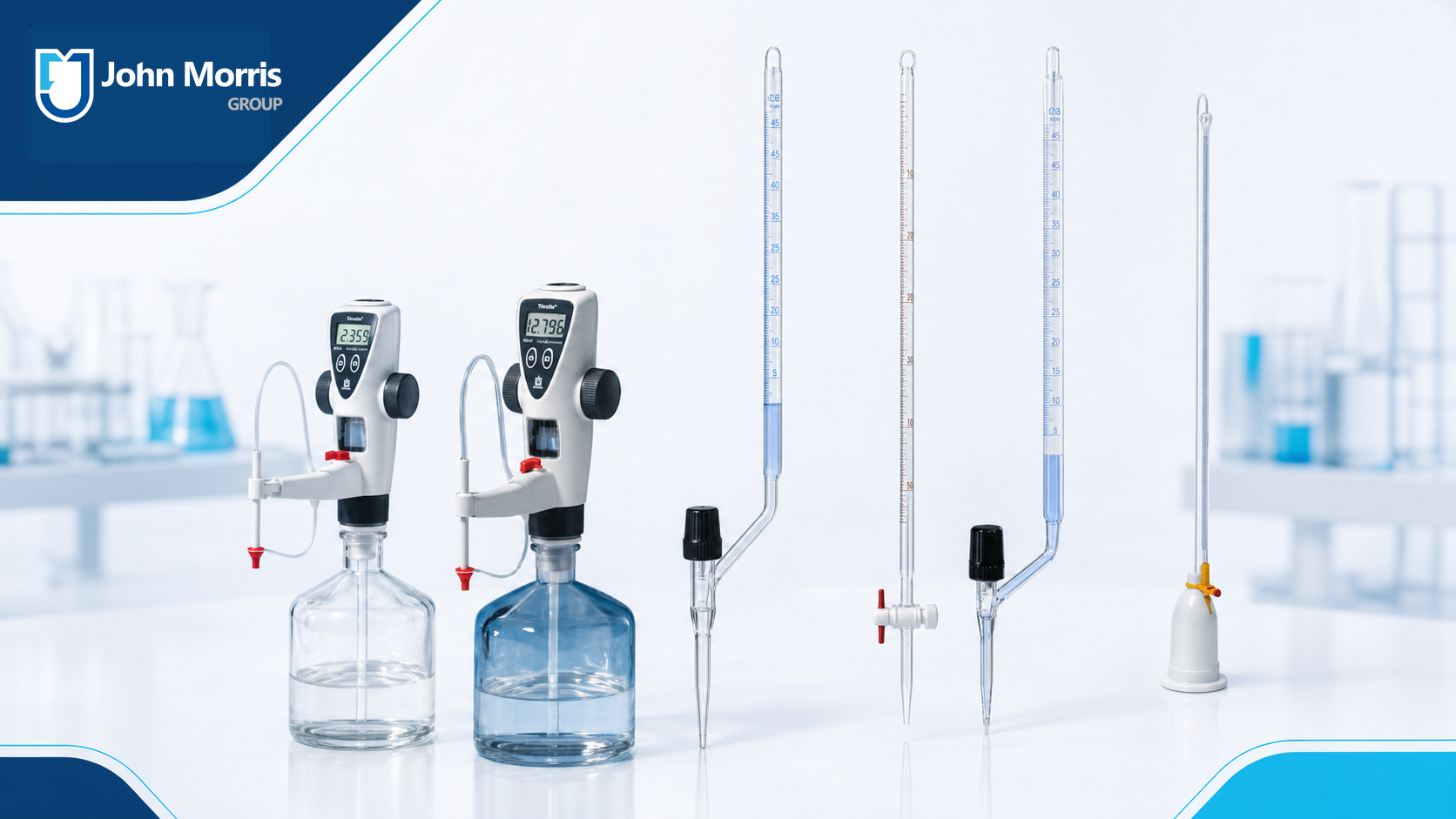
John Morris Group supplies burettes across precision-glass, general-purpose glass, digital, automatic and micro formats.
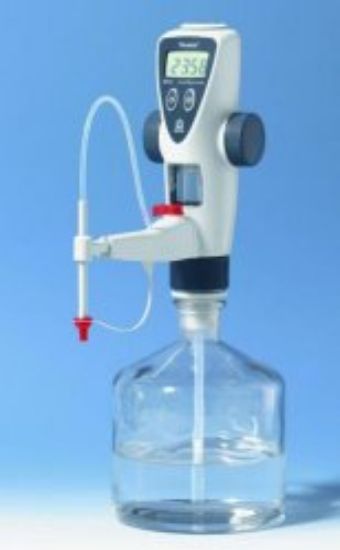
BRAND Digital Titrette Burette, 10 mL
Battery-operated digital burette with Class A accuracy to DIN EN ISO 385, resolution to three decimal places below 20 mL, drop-wise dispensing and a SafetyPrime recycle valve.
Browse This Burette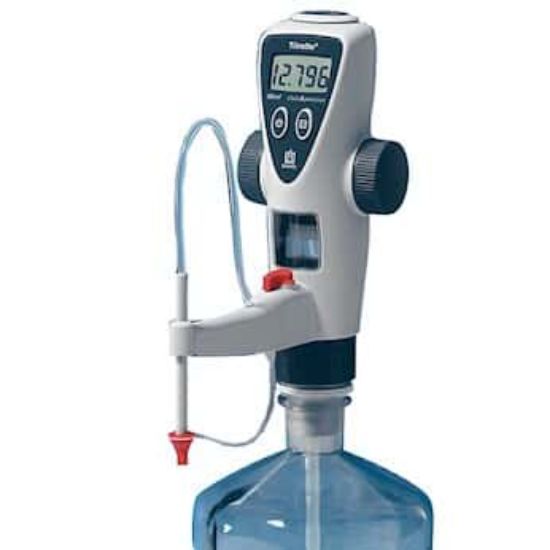
BRAND Titrette Digital Bottletop Burette, 25 mL
Larger-capacity digital bottletop burette for standardised solutions dispensed straight from the reagent bottle, with the same Class A digital accuracy as the 10 mL model.
Browse This Burette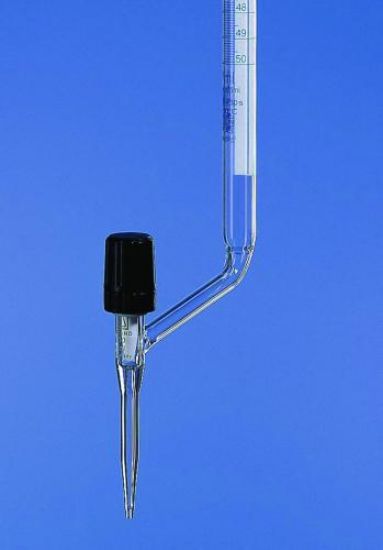
BRAND Burette 50 mL, Class AS, Schellbach
Borosilicate 3.3 glass burette with 0.1 mL graduations, a lateral PTFE valve and a Schellbach stripe for easier, more accurate manual reading.
Browse This Burette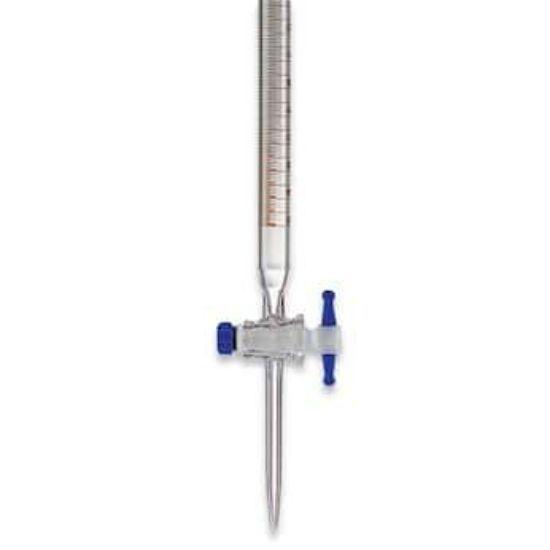
Pyrex Class B Glass Burette, 50 mL
General-purpose 50 mL burette with Class B accuracy, a 2 mm straight-bore PTFE stopcock, coloured scale markings and a dust cover.
Browse This Burette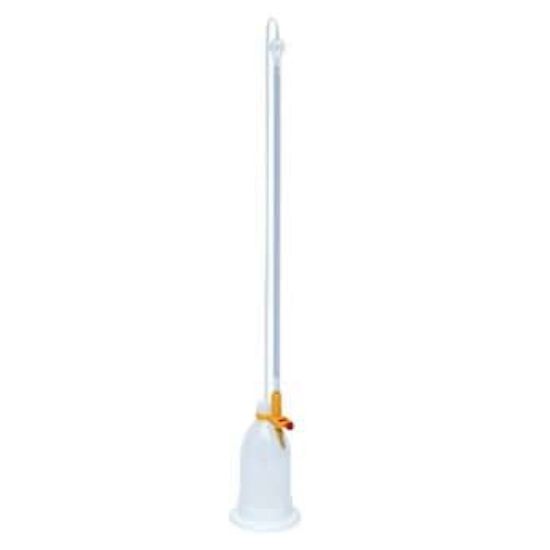
Cole-Parmer Automatic Burette, 50 mL
Self-zeroing automatic burette with a flexible vinyl fill tube, LDPE reservoir bottle and thumb-operated push-button stopcock, with adjustable drop speed for repeat titrations.
Browse This Burette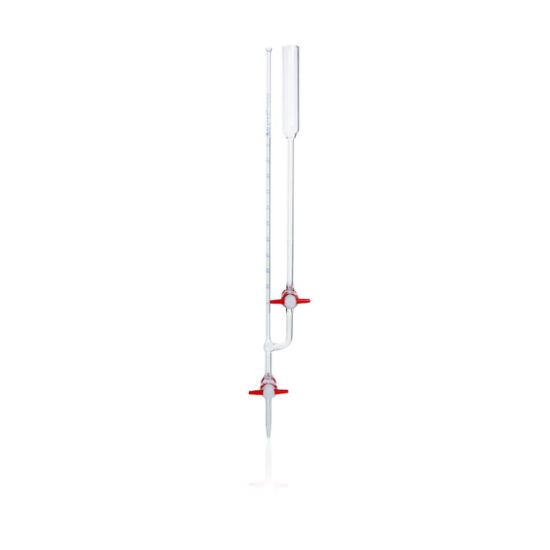
Micro-Burette, 5 mL, AS
Small-capacity burette with fine graduations and a PTFE stopcock, supplied with a batch certificate, for titrations needing high resolution on a small titrant volume.
Browse This BuretteExplore More Lab Glassware Resources
A burette rarely works alone. See how it fits alongside the flask that holds your sample, the glass it's made from, and the care that keeps both accurate.
Erlenmeyer Flask Guide
See why a conical flask is the standard partner to a burette in a titration setup, and how to choose the right size and neck type.
Read The Flask GuideWhat Is Borosilicate Glass?
Learn why borosilicate glass is the standard burette material, and how its properties compare to soda-lime and quartz glassware.
Read The Borosilicate GuideHow To Clean Lab Glassware Properly
Follow the correct rinse and detergent steps to keep a burette's calibration accurate and free of residue between uses.
Read The Cleaning GuideBurette FAQs
What Is A Burette Used For?
A burette is used to dispense a precise, variable volume of liquid, most commonly the titrant in an acid-base, redox, complexometric or precipitation titration. It's also used for general precision dispensing and for standardising reagent solutions.
What Is The Difference Between A Burette And A Pipette?
A pipette delivers one fixed, pre-set volume. A burette lets you dispense any volume up to its capacity and stop wherever you choose, then read exactly how much was delivered from its graduated scale.
Why Is A Burette More Accurate Than A Measuring Cylinder?
A burette's narrower bore and finer, closely spaced graduations give a more precise reading than a measuring cylinder's wider tube and coarser scale. A burette's stopcock also lets you dispense drop by drop right up to an exact endpoint, which a measuring cylinder isn't designed to do.
What Is The Typical Capacity Of A Burette?
50 mL is the most common general-purpose capacity, though burettes are available from micro sizes (1 to 10 mL) for small, high-resolution titrant volumes up to 100 mL for larger-scale work. Choose the smallest capacity that comfortably covers your expected titrant volume, since a smaller burette reads more precisely.
How Do You Read A Burette Correctly?
Keep your eye level with the liquid surface to avoid parallax error, read the bottom of the meniscus for clear liquids (or the top for dark, opaque ones), and record both an initial and a final reading. A Schellbach stripe makes this easier by creating a sharp arrow at the liquid surface.
What Is The Difference Between A Class A And Class B Burette?
A Class A burette is manufactured to a tighter tolerance for higher-precision analytical work. A Class B burette has a wider tolerance, at a lower cost, and suits routine titrations, quality control checks and teaching use. Class AS is a separate, related classification, not another name for Class B; see the next question for how it differs.
What Is The Difference Between Class A And Class AS Burettes?
Class A and Class AS burettes share the same tight accuracy tolerance. The difference is delivery speed: Class AS burettes are designed for faster outflow and specify a shorter waiting time before the final reading, while standard Class A burettes specify a longer wait. Class AS does not mean a lower level of accuracy than Class A.
What Is A Schellbach Burette?
A Schellbach burette has a coloured stripe running down the back of the glass tube. Viewed through the liquid, the stripe creates a sharp, pointed arrow exactly at the meniscus, making an accurate manual reading easier than judging a plain curved meniscus by eye.
Are Digital Burettes More Accurate Than Glass Burettes?
Digital burettes remove parallax and meniscus-judgement error and can display finer resolution, which helps most with high-volume repeat testing or multiple operators. A correctly read Class A glass burette can still achieve comparable accuracy for many routine titrations, so the choice usually comes down to throughput, consistency and budget rather than accuracy alone.
How Do You Clean A Burette Properly?
Rinse the burette immediately after use, wash with an appropriate detergent, rinse thoroughly with tap water, then finish with distilled or deionised water. Check that water wets the inside walls evenly with no beading before storing it, since beading usually means residue or grease is still present.
Need Help Choosing The Right Burette?
Talk to John Morris Group about glass, digital, automatic and micro burettes for titration, quality control and teaching laboratories.
Contact UsCall 1300 501 555 or contact John Morris Group for quotation and technical support.