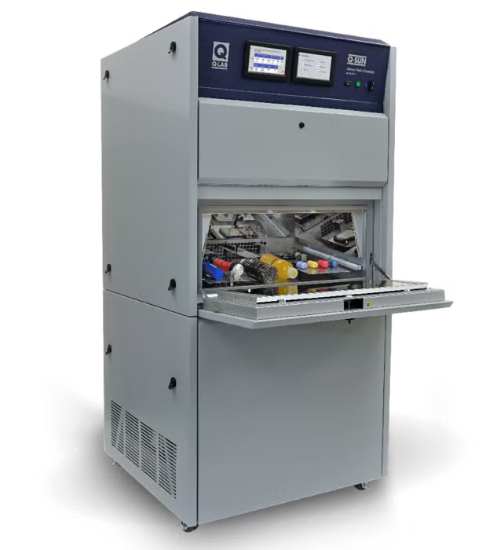
The Q-Lab Q-SUN Xe-3-HBSE Flat-Array Xenon Arc Test Chamber with RH and Front/Back Water Spray is a full-size xenon arc weathering tester for laboratories that need controlled full-spectrum light, temperature, relative humidity and direct water spray on both sides of the specimen. The Xe-3-HBSE model uses three 1800 W full-spectrum ozone-free xenon arc lamps, a large flat-array specimen tray, SOLAR EYE irradiance control and front/back spray capability to simulate sunlight, heat, humidity and rain-driven moisture attack under repeatable laboratory conditions. It is designed for technical buyers testing automotive materials, exterior coatings, plastics, packaging, printed materials, sealants, textiles and three-dimensional components where moisture exposure is central to the degradation mechanism. For laboratories comparing Q-SUN Xe-3 configurations, the Xe-3-HBSE is the humidity plus front/back spray model, without the dual spray reservoir system or chiller package used on other Xe-3 variants.
Test Standards Supported
The Q-SUN Xe-3-HBSE supports xenon arc weathering and lightfastness methods where the selected cycle requires irradiance, chamber air temperature, black panel or insulated black panel temperature, relative humidity and water spray. Because this HBSE configuration includes front and back spray, it is better aligned than Xe-3-HE or Xe-3-HSE for methods requiring moisture exposure on both sides of the specimen.
- ASTM G151, exposure of non-metallic materials in accelerated test devices using laboratory light sources.
- ASTM G155, xenon arc exposure of non-metallic materials.
- ISO 4892-2, plastics exposed to laboratory xenon arc light sources.
- ISO 16474-2, paints and varnishes exposed to laboratory xenon arc light sources.
- ASTM D2565, xenon arc exposure of plastics intended for outdoor applications.
- ASTM D4459, xenon arc exposure of plastics for indoor applications.
- ASTM D6695, xenon arc exposure of paints and related coatings.
- ASTM D7869, xenon arc exposure of automotive coatings, subject to cycle requirements.
- SAE J2412, accelerated exposure of automotive interior trim components.
- SAE J2527, accelerated exposure of automotive exterior materials.
- AATCC TM16 and AATCC TM169, textile lightfastness and weather resistance methods.
- ISO 105-B02, ISO 105-B04, ISO 105-B06 and ISO 105-B10, textile colour fastness and automotive textile exposure methods.
- GB/T 16422.2 and JIS K 7350-2, xenon arc methods for plastics and related materials.
- ICH Guideline Q1B, photostability workflows where the selected test conditions match the Xe-3-HBSE configuration.
Configuration Notes
- This Xe-3-HBSE model includes relative humidity control and front/back water spray.
- This model includes back spray, allowing water to be sprayed on both the front and back of specimens simultaneously.
- This model does not include dual spray. For a second liquid such as acid rain or soap solution, review Xe-3-HDSE or related DS configurations.
- This model does not include a chiller. For lower chamber air temperature operation, review Xe-3-HCE or Xe-3-HSCE configurations.
- This model supports simultaneous chamber air temperature and black panel or insulated black panel temperature control.
- Method suitability depends on the selected optical filter, irradiance control point, temperature setpoint, humidity setpoint and spray requirement.
Key Features
- Full-size Xe-3 flat-array chamber for high-capacity xenon arc weathering and lightfastness testing.
- Three 1800 W full-spectrum ozone-free xenon arc lamps for realistic simulation of sunlight across ultraviolet, visible and infrared wavelengths.
- Relative humidity control from 20-95% for test cycles where humidity affects material degradation, drying behaviour or moisture uptake.
- Front and back water spray capability for methods requiring direct moisture exposure on both sides of the specimen.
- Large 45 x 72 cm flat specimen tray for standard panels, larger specimens and selected three-dimensional parts.
- SOLAR EYE irradiance control with selectable 340 nm, 420 nm or TUV control points for repeatable light exposure.
- Model E feature set with dual touchscreen displays and improved irradiance/lamp efficiency.
- AUTOCAL UC20 calibration compatibility for irradiance control and black panel thermometer calibration.
- Air-cooled xenon lamp design for lower maintenance complexity compared with water-cooled lamp systems.
- Standard Ethernet datalogging plus USB data transfer and software update support.
Performance Specifications
- Chamber type: full-size flat-array xenon arc weathering test chamber.
- Light source: 3 x 1800 W full-spectrum ozone-free xenon arc lamps.
- Specimen capacity: 55 specimens at 51 x 102 mm.
- Specimen area: 45 x 72 cm, depth x width.
- Specimen orientation: 10° measured from horizontal.
- Maximum evenly distributed specimen weight on tray: 23 kg.
- Black panel temperature range: 45-110 °C in light, 40-90 °C with IR filter and 25-50 °C in dark.
- Insulated black panel temperature range: 50-120 °C in light, 45-100 °C with IR filter and 25-50 °C in dark.
- Chamber air temperature range: 35-65 °C in light and 25-50 °C in dark.
- Relative humidity range: 20-95%.
- Water consumed with front and back spray on: 0.4 L/min.
- Humidifier water consumption: 44 L/day, with actual use dependent on test and laboratory conditions.
- External dimensions: 91 x 178 x 99 cm.
- Weight: 190-233 kg, depending on configuration.
- Electrical requirements: 208 V or 230 V, 3-phase at 39 A, 50/60 Hz; 400 V, 3-phase at 26 A.
Specimen Capacity and Configuration
The Q-SUN Xe-3-HBSE uses a large flat-array specimen tray with a 45 x 72 cm exposure area and capacity for 55 specimens at 51 x 102 mm. The near-horizontal 10° specimen orientation is useful for weathering tests where light, heat, humidity and water spray need to be applied to flat panels, larger specimens or selected three-dimensional parts. Q-Lab notes that the Xe-1 and Xe-3 specimen capacities are listed without specimen holders, so holder selection should be confirmed during configuration.
The key configuration advantage of the Xe-3-HBSE is its ability to spray water on both the front and back of specimens. This is valuable for test cycles where moisture exposure behind or through the specimen is part of the degradation mechanism, or where the method requires more realistic moisture interaction than front-side spray alone. For automotive materials, textiles, coated flexible substrates and selected component tests, the front/back spray configuration can provide a closer match to the required exposure profile than a front-spray-only chamber.
Operating Specifications
The Xe-3-HBSE is an S model because it includes spray, so it requires higher-purity water than non-spray configurations. Q-Lab lists the water requirement for all S or W models as inlet pressure of 2.1-6.2 bar, resistivity greater than 5 MΩ.cm, conductivity less than 0.2 μS/cm, total dissolved solids less than 0.1 ppm and colloidal silica less than 0.1 ppm. Q-Lab also recommends maintaining pH 6-8 for best performance, and using a reverse osmosis/deionisation system for S models.
For facility planning, the Xe-3-HBSE external dimensions are 91 x 178 x 99 cm, with a listed weight range of 190-233 kg depending on configuration. Q-Lab notes that the rear Xe-3 vent duct can be removed to reduce the chamber depth from 99 cm to 88 cm for movement through small doors. The electrical requirement is 208 V or 230 V, 3-phase at 39 A, with a 400 V, 3-phase at 26 A option shown in the operating specifications.
The recommended laboratory ambient condition is 23 ± 5 °C and 50 ± 25% relative humidity. Q-Lab notes that operation outside these conditions can cause temperature, humidity or other faults, and the chamber should not be operated in laboratory ambient conditions above 36 °C or above 80% RH. These details are important for Australian and New Zealand laboratories planning installation in production quality areas, shared test laboratories or spaces with seasonal ambient variation.
Why Choose the Q-Lab Q-SUN Xe-3-HBSE?
The Q-Lab Q-SUN Xe-3-HBSE is the correct Xe-3 choice when a laboratory needs a large flat-array xenon arc tester with RH control and water spray on both sides of the specimen. Compared with Xe-3-HE, it adds spray exposure. Compared with Xe-3-HSE, it adds back spray. Compared with Xe-3-HDSE, it focuses on front/back pure water spray rather than a dual spray system for a second liquid. Compared with Xe-3-HCE, it does not include a chiller, so it is best suited to methods that do not require lower chamber air temperature operation.
For technical buyers, the main commercial value is capability alignment. The Xe-3-HBSE combines three air-cooled xenon lamps, SOLAR EYE irradiance control, humidity control, BP or IBP plus CAT control, front/back water spray, AUTOCAL calibration and a large flat specimen tray. This supports repeatable, documented weathering and lightfastness testing for quality control, R and D screening, supplier comparison, formulation validation and customer specification work.
John Morris Group supplies Q-Lab capital test equipment across Australia, New Zealand, Sri Lanka and the Pacific Islands, supporting customers with model selection, facility planning, calibration workflow, installation considerations and after-sales support. Contact John Morris Group for a quote on the Q-Lab Q-SUN Xe-3-HBSE Flat-Array Xenon Arc Test Chamber with RH and Front/Back Water Spray, including confirmation of the correct optical filters, detector assembly, specimen holders, calibration accessories, water purification, electrical services and installation requirements for your test programme.