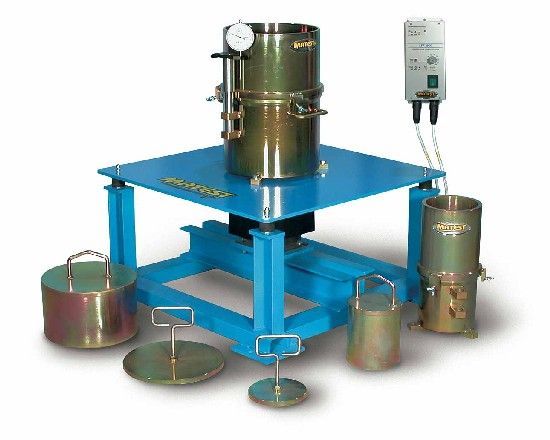
The MATEST Relative Density of Cohesionless Soils, EN Spec., is a complete testing system designed to determine the maximum dry density and water content of granular, cohesionless soils used in road construction and other geotechnical projects. This method is ideal for mixtures where vibratory compaction produces higher densities than the impact method, and is applicable to materials with up to 12% fines and a maximum particle size of 80 mm. The complete system includes a vibrating electromagnetic table, a 14 litre capacity mould, and EN-compliant surcharge weights and accessories, ensuring precise and repeatable testing according to European standards.
Product Features
- S238-10 Vibrating electromagnetic table (762 × 762 mm) with vibration frequency of 3600 rpm
- Amplitude range adjustable from 0.05 to 0.64 mm for tailored compaction
- High load capacity up to 250 kg, complete with a separate, easy-to-use control panel
- S238-11EN Relative density mould with 14 litre capacity and full set of accessories
- S238-12 EN-compliant surcharge weight and base with handle for standardised testing
- Conforms to European standards for accurate and reliable test results
Benefits
- Precise density measurements – Ensures correct compaction control for road construction and granular fill
- Comprehensive system – Includes all key components needed for complete relative density testing
- Adjustable vibration amplitude – Tailor compaction levels to specific soil conditions
- Durable and heavy-duty – Built to handle large sample sizes and repeated field or lab use
- Standard compliant – Fully aligned with EN specifications for cohesionless soil testing
Why Choose the MATEST Relative Density of Cohesionless Soils System?
Designed for engineers and geotechnical professionals, the MATEST Relative Density of Cohesionless Soils system delivers reliable, repeatable measurements essential for quality assurance in road construction and granular soil applications. Its robust design, adjustable features, and compliance with EN standards make it a practical choice for both laboratory and field environments where precision matters.