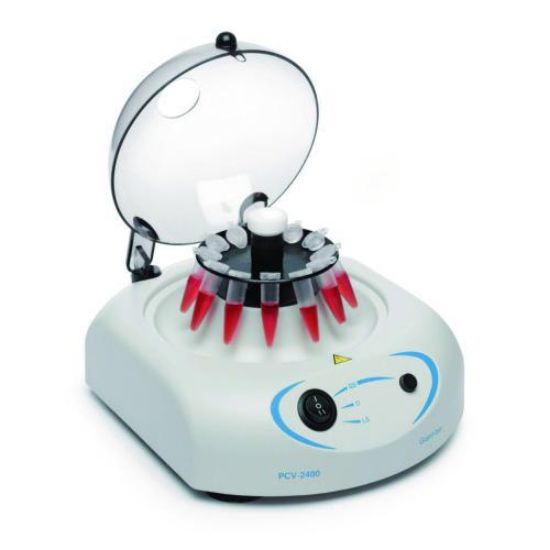
Grant Instruments PCV-2400 Combispin Centrifuge/Vortex Mixer combines the functionality of a centrifuge and vortex mixer in a single compact unit. Ideal for laboratories working with microtubes and 0.2 ml strips, it allows independent centrifugation and vortex mixing, or concurrent spin-mix-spin operation with very low reagent volumes.
Product Features
- Combined centrifuge/vortex mixer for microtubes and 0.2 ml strips
- Independent centrifuge and vortex mixing, or mixing of an individual tube concurrently with spinning of multiple tubes
- Vortex cup located at the top of the central shaft emerges through an opening in the closed lid
- Spin-mix-spin applications suitable for very low reagent volumes
- Continuous operation or short spin mode
- Further rotors available as options: 8 x 1.5/2.0 ml + 8 x 0.5 ml microtubes
- Further rotors available as options: 6 x 1.5/2.0 ml + 6 x 0.2 ml microtubes
- Further rotors available as options: 2 x 8-well 0.2 ml strips
- Includes EU and UK plug
Scope of Supply
- Centrifuge
- Rotor for 12 x 1.5 ml tubes
- Rotor for 12 x 0.5 ml tubes
- Rotor for 12 x 0.2 ml tubes
Specifications
- Max. RCF: 700 x g
- Max. speed: fixed at 3500 rpm
- Max. capacity: 12 x 1.5 ml or 12 x 0.5 ml + 12 x 0.2 ml or 2 x 8-well strips 0.2 ml
- Power consumption: 11 W
- Dimensions (W x D x H): 190 x 235 x 125 mm
- Weight: 2.1 kg
- Power supply: 120 – 230 VAC, 50/60 Hz, 12 VDC
Benefits
- Combines centrifugation and vortex mixing in one compact unit
- Allows efficient mixing of microtubes and strips with low reagent volumes
- Flexible operation modes: continuous, short spin, or spin-mix-spin
- Optional rotors expand versatility for different tube sizes
- Compact and lightweight design suitable for small laboratory benches
Why Choose Grant Instruments PCV-2400 Combispin?
The Grant Instruments PCV-2400 Combispin Centrifuge/Vortex Mixer offers laboratory efficiency, precision, and versatility. Its combined functionality, compact footprint, and flexible operation modes make it ideal for laboratories handling microtubes and low-volume samples.