In laboratory and industrial environments, viscosity is one of the most critical yet frequently misunderstood fluid properties. A small error in measurement can lead to failed batches, poor product performance, or equipment damage. At its simplest, viscosity is a measure of how much a fluid resists flowing. Water flows easily because it has low viscosity. Honey flows slowly because it has high viscosity. At a more technical level, viscosity comes from internal friction between layers of a fluid as they slide past each other.
Understanding viscosity is only the first step. The real challenge in most labs is measuring it accurately under controlled conditions. This guide covers what viscosity is, why it matters across Australian industries, the key measurement methods and equipment, and the most common mistakes that lead to unreliable results.
Viscosity Definition
Viscosity is the measure of a fluid's internal resistance to flow. A high-viscosity fluid (like honey) flows slowly. A low-viscosity fluid (like water) flows quickly. Viscosity is measured in centipoise (cP) for dynamic viscosity or centistokes (cSt) for kinematic viscosity.
Why Viscosity Matters in Real Applications
Petrochemical and fuel testing: Viscosity determines whether lubricants, engine oils, and fuels meet performance specifications. An oil that is too thin will not protect engine components under load. Too thick and it will not flow properly at low temperatures. Australian labs testing to ASTM D445, D2171, and SAE J300 specifications rely on precise viscosity data for compliance. Cannon Instruments and PAC systems are widely used for these applications.
Coatings, inks, and paints: Viscosity controls whether a product sprays evenly, levels correctly, or drips and runs. This is why flow cups like Ford and Zahn cups are standard across the coatings industry.
Food and beverage: Viscosity defines texture, mouthfeel, and consistency. A sauce that varies between batches is immediately noticeable to consumers. QC labs use rotational viscometers to ensure each batch meets specification.
Pharmaceutical and cosmetics: Viscosity affects spreadability of lotions, pourability of syrups, and dispensing consistency of creams. Products that are slightly off specification can fail stability tests or deliver a poor user experience.
Mining and slurry handling: In Australian mining operations, pumps must be selected to handle thick, abrasive, or corrosive fluids. If a fluid's viscosity is not properly characterised, the wrong pump selection can lead to impeller fouling and significant operational failures.
Dynamic Viscosity vs Kinematic Viscosity
These two terms are frequently confused, even in professional laboratory settings. Understanding the difference is important because the wrong measurement type can lead to incorrect equipment selection and unreliable data.
| Factor | Dynamic (Absolute) Viscosity | Kinematic Viscosity |
|---|---|---|
| What it measures | Resistance to shearing forces between fluid layers | Resistance to flow under the influence of gravity |
| Unit | Centipoise (cP) or Pascal-second (Pa.s) | Centistokes (cSt) or mm²/s |
| Relationship | Measured directly | Dynamic viscosity divided by fluid density |
| Common industries | Chemicals, cosmetics, food, pharmaceuticals | Petroleum, automotive, lubricants |
| Measured with | Rotational viscometers | Capillary viscometers, flow cups |
The key takeaway: two fluids can have the same dynamic viscosity but flow at different rates under gravity if their densities differ. This is why petroleum labs use kinematic viscosity (cSt) while food and cosmetics labs typically use dynamic viscosity (cP). Always confirm which type your specification requires before selecting your measurement method.
How to Measure Viscosity: Methods and Equipment
1. Efflux (Flow Cup) Methods
The simplest and most widely used method in production environments. A liquid is poured into a cup with a precisely sized orifice at the bottom, and the time taken for the liquid to drain is recorded. Common tools include the BYK-Gardner Ford Cup and Zahn Cup. Best for paints, inks, coatings, and quick QC checks on production lines.
2. Rotational Viscometers
These instruments measure the torque required to rotate a spindle immersed in the fluid. By varying spindle speed, they can characterise how viscosity changes with shear rate, making them essential for non-Newtonian fluids like cosmetic creams, food sauces, and pharmaceutical gels. The Lamy Rheology B-One Plus covers both low-viscosity (LV) and standard (RV) ranges in a single instrument, while the Atago VISCO-2 offers a compact, portable option for field and production use.
3. Capillary Viscometers
Used for high-precision laboratory measurements, particularly in petroleum testing. A fluid flows through a calibrated glass capillary tube under gravity, and the flow time is used to calculate kinematic viscosity. This is the standard method for ASTM D445 testing. Cannon Instruments capillary viscometers and certified viscosity standards are widely used in Australian petroleum and lubricant laboratories.
4. Automated and Specialised Systems
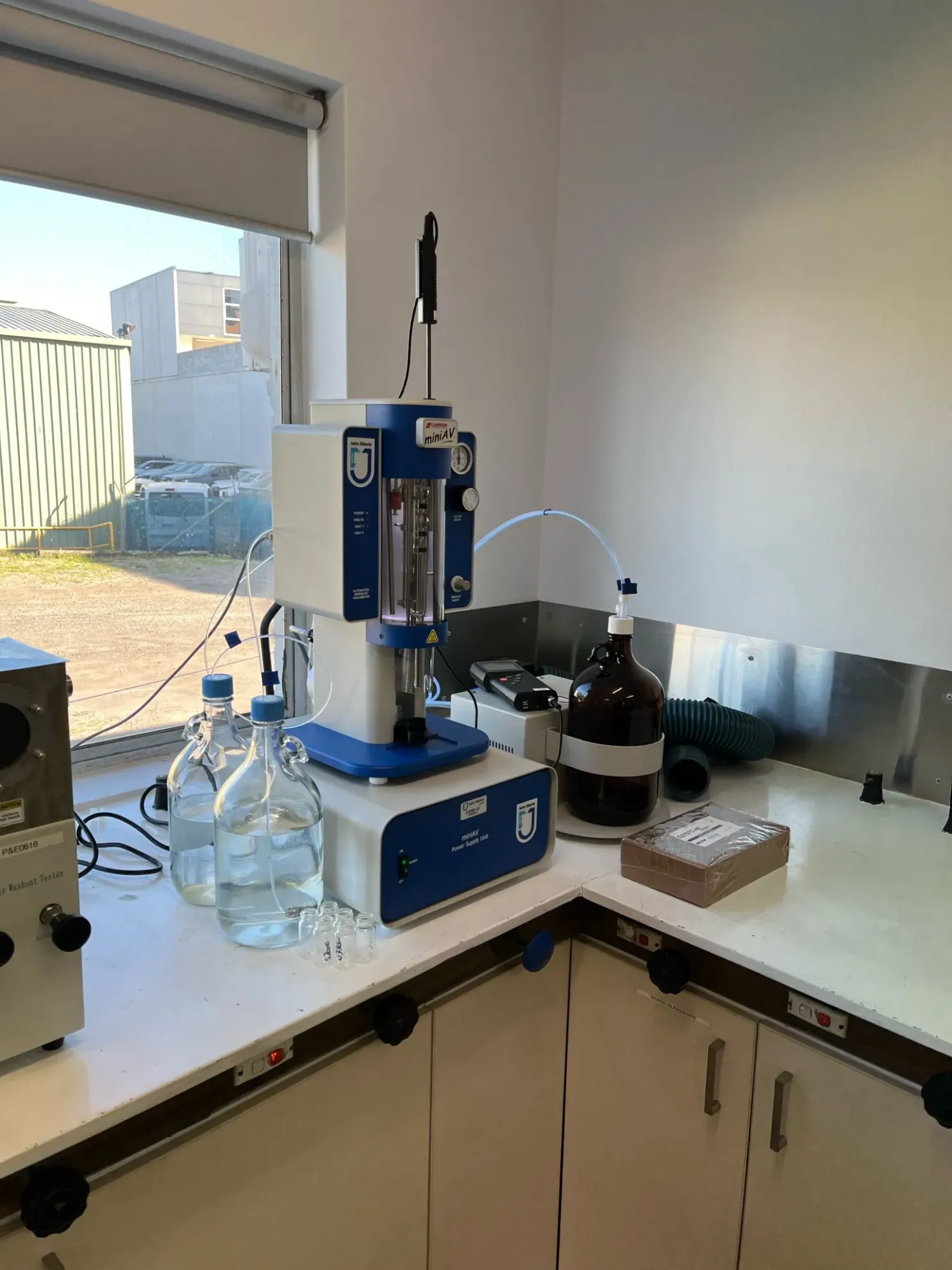
For high-throughput or extreme-condition testing, automated systems eliminate operator variability and improve repeatability. The Cannon CAV-5 Automated Viscometer and Cannon MiniAV are among the most popular systems in Australian petroleum and manufacturing labs, delivering fully automated kinematic viscosity measurement to ASTM D445. For low-temperature engine oil testing, the Cannon Cold Cranking Simulator (CCS) measures viscosity at temperatures down to -40°C to verify lubricant performance under cold-start conditions. The PAC VH2 Houillon Viscometer uses a capillary method requiring less than 1 mL of sample, making it ideal for both transparent and opaque samples.
Common Mistakes When Measuring Viscosity
The Temperature Trap
The single most common cause of inconsistent viscosity results is poor temperature control. Viscosity is extremely sensitive to thermal changes. For certain lubricants, viscosity can double with a temperature change of only 5°C. In real lab environments, we frequently see samples tested before they have reached thermal equilibrium, or labs skipping the water bath step entirely. The result is unreliable data and incorrect conclusions about product performance. Always equilibrate samples to the specified test temperature before beginning measurement.
Other frequent mistakes include:
- Treating non-Newtonian fluids as Newtonian: Products like toothpaste, mayonnaise, and cosmetic creams change thickness depending on the shear rate applied. Measuring them at a single speed and assuming the result represents real-world behaviour leads to products that are too thick to dispense or too thin to perform properly.
- Neglecting air bubbles: In high-viscosity materials, air bubbles trapped during mixing can cause significant defects and inaccurate readings. Vacuum degassing before measurement is essential for reliable results.
- Confusing viscosity with density: A fluid can be thick (high viscosity) but have low mass density, or vice versa. This distinction matters when selecting pumps and processing equipment.
- Confusing dynamic and kinematic viscosity: Using the wrong unit or measurement type for your specification can invalidate results entirely. Always confirm whether your standard requires cP (dynamic) or cSt (kinematic).
- Skipping calibration: Using viscosity standards like Cannon HT39 or Cannon N2 ensures your viscometer is delivering accurate, traceable results. Without regular calibration, even expensive instruments drift over time.
How to Choose the Right Viscometer
| Application | Best Method | Recommended Equipment |
|---|---|---|
| Paints, coatings, inks | Flow cups (efflux) | BYK-Gardner Ford Cup, Zahn Cup |
| Food, cosmetics, pharma | Rotational viscometer | Lamy Rheology B-One Plus, Atago VISCO-2 |
| Petroleum, lubricants | Capillary / automated | Cannon CAV-5, PAC VH2 Houillon |
| Low-temp engine oils | Cold cranking simulator | Cannon CCS |
| Low viscosity fluids | Specialised rotational | Atago VISCO Package B |
Viscometer vs Rheometer: What Is the Difference?
A viscometer measures viscosity at one or a few fixed conditions. It tells you how thick a fluid is. A rheometer measures how viscosity changes across a range of shear rates, temperatures, and time. It tells you how a fluid behaves under different conditions.
For most Australian QC labs testing to a specification (ASTM, ISO, or internal), a viscometer is the right tool. For R&D labs developing new formulations or characterising complex non-Newtonian fluids, a rheometer provides the deeper insight needed to predict real-world performance. Many rotational viscometers like the Lamy Rheology B-One Plus can perform basic rheological profiling by testing at multiple speeds, bridging the gap between the two.
Explore our full range of viscometers and viscosity standards or read our detailed product guide on the Cannon CAV-5 Automated Viscometer for petroleum testing applications.
Viscosity Measurement Brands at John Morris Group
- Cannon Instruments: The global standard for capillary viscometry and petroleum testing. Automated viscometers (CAV-5), cold-cranking simulators, and ASTM-certified viscosity standards.
- Stanhope Seta: Precision fuel, lubricant, and petrochemical testing instruments including kinematic viscosity baths.
- PAC: Houillon capillary viscometers for petroleum and petrochemical analysis requiring minimal sample volumes.
- Lamy Rheology: Rotational viscometers and texture analysers for food, cosmetics, coatings, and pharmaceutical applications.
- Atago: Compact, portable viscometers for field and production use, including specialised packages for low-viscosity samples.
Frequently Asked Questions
What is viscosity?
Viscosity is the measure of a fluid's internal resistance to flow. High-viscosity fluids like honey flow slowly. Low-viscosity fluids like water flow quickly. It is measured in centipoise (cP) for dynamic viscosity or centistokes (cSt) for kinematic viscosity.
What is the difference between dynamic and kinematic viscosity?
Dynamic viscosity measures a fluid's resistance to shearing forces between layers. Kinematic viscosity measures resistance to flow under gravity and equals dynamic viscosity divided by density. Petroleum labs typically use kinematic (cSt), while food and cosmetics labs use dynamic (cP). Always confirm which your specification requires.
What is a non-Newtonian fluid?
A non-Newtonian fluid changes viscosity depending on the force applied to it. Ketchup becomes thinner when squeezed (shear-thinning). Cornstarch and water becomes thicker under impact (shear-thickening). Measuring these fluids requires a rotational viscometer that can test at multiple shear rates.
Why does temperature affect viscosity?
Most fluids become less viscous (thinner) as temperature increases. For some lubricants, viscosity can double with a drop of only 5°C. This is why most viscosity test methods specify a precise test temperature (commonly 25°C, 40°C, or 100°C) and require thermal equilibration before measurement.
What units is viscosity measured in?
Dynamic viscosity is measured in centipoise (cP) or Pascal-seconds (Pa.s). Kinematic viscosity is measured in centistokes (cSt) or mm²/s. The choice of unit depends on the industry and test standard. Petroleum labs typically use cSt, while food and cosmetics labs use cP.
What is a viscometer used for?
A viscometer measures the viscosity of a fluid. It is used in quality control, product development, and regulatory compliance across industries including petroleum, food, pharmaceuticals, coatings, and cosmetics. Different types of viscometers suit different applications: flow cups for coatings, rotational viscometers for complex fluids, and capillary viscometers for petroleum testing.
Where can I buy viscometers in Australia?
John Morris Group supplies viscometers from Cannon Instruments, Atago, Lamy Rheology, PAC, and Stanhope Seta across Australia and New Zealand with local technical support and service. Call 1300 501 555 or browse our laboratory and scientific equipment online.
Need Help Selecting a Viscometer?
Our technical team helps Australian labs and industrial facilities select the right viscosity measurement method and equipment for their specific fluids and compliance requirements. From quick production checks with flow cups to fully automated petroleum testing systems, we provide expert guidance from specification through to installation.
Call 1300 501 555 or browse our Cannon, Atago, and Lamy Rheology ranges online.