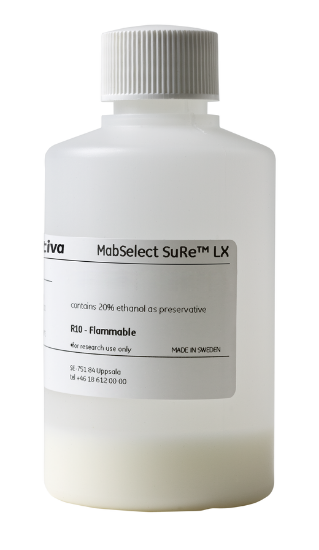
The MabSelect SuRe LX Protein A Resin, 200 mL (17547402) is a protein A affinity chromatography resin developed for capture of monoclonal antibodies in high-titer processes. It combines high dynamic binding capacity with alkaline stability, supporting efficient antibody purification, robust cleaning-in-place workflows, and process-scale chromatography development.
Key Features
- 200 mL bulk resin format, supplied as MabSelect SuRe LX protein A resin for antibody capture workflows
- High dynamic binding capacity, with approximately 60 mg human IgG/mL medium at 6 min residence time
- Alkali-stabilised protein A-derived ligand, produced from E. coli and designed for protein A affinity purification
- Rigid highly cross-linked agarose matrix, supporting high-flow process chromatography applications
- Single-point ligand attachment, with epoxy coupling chemistry for controlled ligand immobilisation
- Average 85 µm particle size, based on median particle size of the cumulative volume distribution
- High mobile phase velocity, with maximum mobile phase velocity of 500 cm/h under specified test conditions
- Cleaning-in-place stability, supporting 0.1 to 0.5 M NaOH for CIP workflows
Benefits
- Helps process high-titer monoclonal antibody feeds using smaller unit operations or shorter processing times.
- Supports process economy through high binding capacity and compatibility with sodium hydroxide cleaning conditions.
- Helps reduce ligand leakage risk through enhanced protease resistance of the protein A ligand.
- Supports platform purification workflows by enabling more generic elution conditions across different monoclonal antibodies.
Why Choose the MabSelect SuRe LX Protein A Resin, 200 mL (17547402)?
The MabSelect SuRe LX Protein A Resin, 200 mL (17547402) is a suitable choice for laboratories and manufacturers developing high-capacity monoclonal antibody capture processes. John Morris Group supplies Cytiva chromatography resins to Australian laboratories, helping users source verified consumables for downstream purification and bioprocess development.